
The Journal · Equipment guide
Choosing a Skateboard – Complete beginner's guide
Your first skateboard should suit what you want to do. Start with the surface you will ride on, understand the parts and choose a setup that makes you want to ride.
Start the guide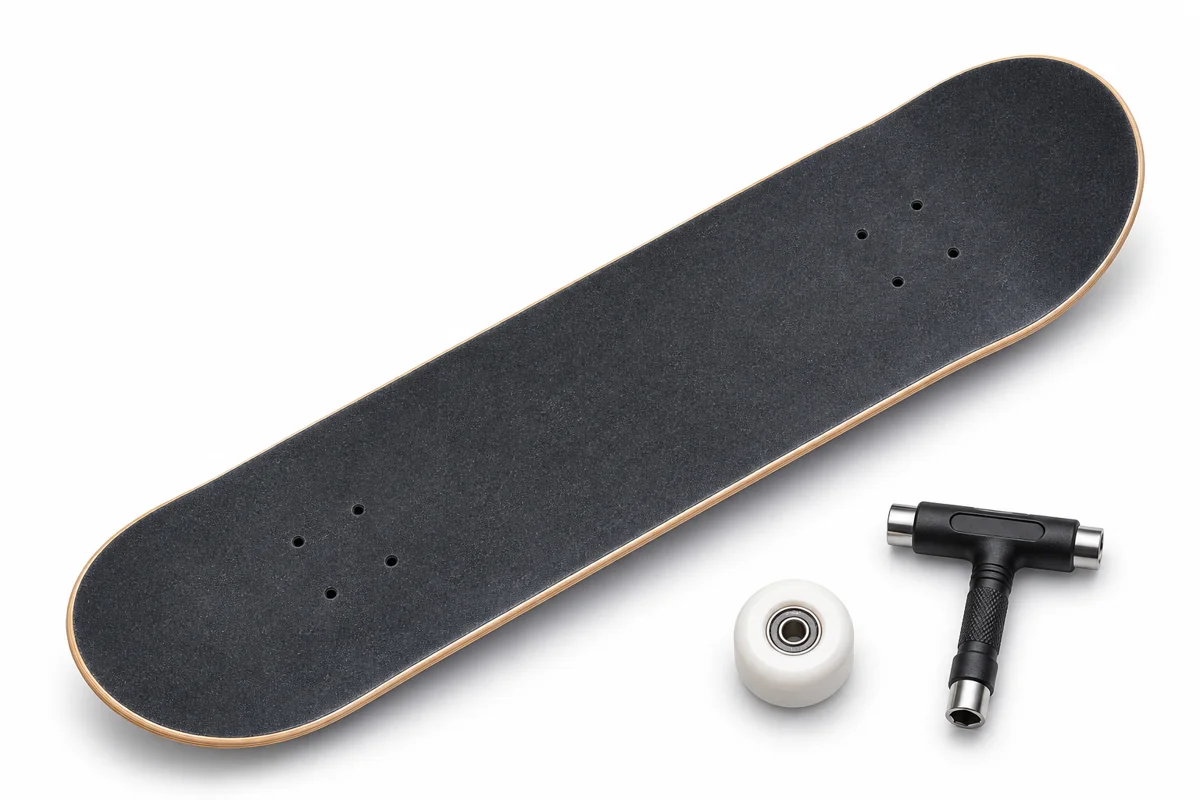
Cruising, street, skatepark or bowl
Width, shape and sensations
Compatible components
How do you choose the right skateboard deck?
Welcome, if you want learn skateboarding you're in the right place. Choosing the right skateboard can seem complicated when you're looking into it for the first time.
Don't panic, we'll help you!
We've put together our 15 years of experience in teaching skateboarding, along with a few articles found online, to guide you through this simple, comprehensive article. If you have questions, contact us directly!

First, decide what kind of skating you want to do: cruise around, skate street (in the streets), go to the skatepark or skate bowls. When starting out, people generally prefer a versatile board that lets them try a bit of everything without overthinking it.
Cruiser: cruising - Choose a longboard, a cruiser or a surfskate. Soft wheels make all the difference.
Street skating: skate in the streets - Choose a standard (traditional) skateboard
The bowl: shaped like an empty pool that recreates a wave - Choose a wider skateboard
The skatepark: a facility for skateboarding (with various obstacles for jumping and sliding) - Choose a skateboard with hard wheels
Do tricks: On flatground, at the skatepark, in the street or in a bowl: choose a skateboard with hard wheels and a deck that isn't too wide
Like on a surfboard: Choose a surfskate
It's hard to tell you exactly what you need without knowing you, so please don't hesitate to call us, on insta or by e-mail. Nous te renseignerons avec grand plaisir.
Choosing a skateboard - The size
Next, start by choosing your deck width. A narrow board measures between 7.5 and 7.8 inches. Medium boards are 8 to 8.5 inches, and a wide board is at least 8.5 inches.
The wider the board, the more comfortable riding will be, because width affects stability. Conversely, a narrower deck is easier to maneuver for tricks. Be aware, though: if you are tall, you may not feel very comfortable on a narrow board. Keep that in mind when buying.

- Narrow boards: 7.5 inches to 7.8 inches
- Intermediate boards: 8.0 inches to 8.5 inches
- Wide boards: beyond 8.5 inches
Our online shop offers you Choose your board. Nous te proposons des complete packs or a deck on its own. Our products are of very good quality and we use them every day in any situation: to give classes, compete or have fun.
| Deck width (indicative) | Size body |
|---|---|
| 7.2"-7.75" | < 140 cm |
| 7.75"-8.0" | 140 – 160 cm |
| 8.0"-8.5" | 160 – 180 cm |
| >8.5" | 180 – 200 cm |
| > 9" | > 200 cm |
| Deck width (indicative) | Shoe size |
|---|---|
| 7.75"-8.0" | 40/7US to 42/8.5US |
| 8.0"-8.5" | 42.5/9US to 44/10US |
| >8.5" | 44.5/10.5US to 45.5/11US |
| > 9" | 46/12US and above |
Choosing a skateboard -The shape
The skateboard deck is made from Canadian maple, with 7 stacked plies glued and pressed in a mould. The mould gives the board more or less concave: flatter or more curved underfoot, with varying angles at the raised tail at the back and nose at the front.
The deck: The deck on its own
The concave: flat or raised
The shape: The shape of the board
The nose and the tail: front and rear
Every skateboard deck has a more or less pronounced concave:

1. Low concave
2. Medium concave (medium)
3. High concave
The following are examples of different shapes:

1. Classic shape
2. Old-school shape
3. Pool shape
The "normal" skateboards
The skateboard we call “normal” has a nose and a tail that let you pop the board and perform tricks on flat ground, at the skatepark and in a bowl. It has the familiar skateboard shape and hard wheels: it’s as simple as that. You can find it everywhere; it’s the most common type of skateboard.
Cruisers, Longboards and Surfskates
The Cruisers vary in length, width and shape. What makes them distinctive is that they're generally shorter than a standard skateboard, with softer wheels and easy handling. That makes them ideal for getting around town, from point A to point B. They usually have a small upturned tail and a flat nose.
You can buy fully assembled cruisers, but we can also build one for you on request. If a longboard is too big for you, a cruiser is a great choice.
The Longboards are longer and harder to carry under your arm, but much more comfortable and easier to learn on. Ideal for downhill riding and cruising!
The Surfskate are also an option if you want to surf as you would on a wave, but on land. A special system in the front truck lets you build speed by turning, without putting your foot on the ground to push. All you have to do is surf, it's fun. !
Now that you have an idea of the types of boards, you're gonna be able to take the time to choose your skateboard depending on what you enjoy, how you want to skate and, above all, what terrain you'll be skating.
Tips!
For beginners, choosing the right kind of spot straight away can be tricky. It's better to choose a complete skateboard setup that lets you progress at almost any spot, so you're not limited to one style of skating. As we explained a few lines above, deck size is the first choice to make when buying a skateboard.
For a versatile skateboard that handles a range of terrain, here’s our advice for building your custom setup.
Child: Classic skateboard shape for skatepark riding and tricks
Adult: Cruiser skateboard with softer wheels for a more comfortable ride
Do tricks: Choose a classic shape with hard wheels
Bowl skating: Choose a wide board with wider wheels
Cruising around town: use soft wheels! Choose any shape
Of course, all our advice is just a recommendation; you don’t have to follow it to the letter. You actually get used to a new board quite quickly. What matters most is that you’re happy with it!
More tips for choosing a skateboard
If you have any questions or would like to learn skateboarding, we've been here for you for 15 years. Young or old, we're here to help you develop at your own pace or make serious progress! Feel free to contact us directly.
Join us every day for Skateboard lessons (kids & adults) or during the school holidays for Camps, some Skate Camps for enthusiasts, and our new package of comfortable stays in La Villa Surf Hossegor For adults this summer!

Choosing the right skateboard - Trucks
Let's keep it simple. Without them, skateboarding won't get very far. The trucks allow you to:
- To attach your wheels to your board
- To turn
- To grind (slide between the wheels)
The width:
As a rule, you'll choose between widths of 129 mm, 139 mm and 149 mm. There are wider and narrower options, and even sizes in between… but those are exceptions. The 3 widths we suggest will match your board perfectly, without the hassle.
We have found a quick guide below that shows which trucks fit which decks. It is easy.

They generally line up with the edges of the board
Tip: your trucks should match your deck’s width, but it’s fine if your deck is slightly wider than your trucks.

For example: 149 mm trucks suit a deck width of 8.25" to 8.5" — easy!
The height:

1. Truck height
2. Wheel size
Brands generally offer a choice of 3 heights: “low”, “mid” and “high”.
“Low” for smaller wheels and “high” for larger cruiser-style wheels
Tip: if you want to try bigger wheels, you can do it without buying new trucks straight away. Just fit riser pads (plastic spacers) between the trucks and the deck to increase the clearance.
A quick glossary to help you speak the language of skateboarding:
Board: The board
Grip tape: non-slip strip on top
Ollie: Jumping on a skateboard
Regular: left-foot-forward stance
Goofy: right-foot-forward stance
Switch: goofy skaters switch to regular and regular skaters switch to goofy. A little extra challenge :)
There you go—we hope we've cleared the way and made choosing your skateboard a little easier.
If you need advice, of lessons or simply talk skateboarding, we're here for you every day of the week. Our online shop is also here to offer high-quality equipment that our riders use in all conditions—and it's all in limited collections. So go for it!
And if you're part of the club You also have discounts that apply directly!
Choose your wheels according to your terrain
Diameter is measured in millimetres; hardness is often measured on the A scale. These are two different pieces of information. A bigger wheel is not automatically a harder wheel.
The ground under your wheels
On rough ground, a softer wheel compound favours comfort. On smooth concrete, harder wheels often suit trick and slide practice.
The clearance under the deck
The diameter must suit your truck height and adjustment. A large wheel can touch the deck when you turn: this is wheelbite.
Your actual use
For getting around and skating parks, look for a compromise that suits your spots. The urethane formula and wheel shape matter too, not just the number printed on the wheel.
| Your need | What you compare | To be checked |
|---|---|---|
| Cruising and uneven ground | Soft wheels, such as 78A for some cruising wheels | Comfort and clearance beneath the deck |
| Street and smooth skatepark | Harder wheels; 99A and 101A are common examples | Grip, slide and a compatible diameter |
| Mixed use | Medium-hard bushings or versatile formulas | The manufacturer's advice for your skating surface |
Compare hardness ratings on the same scale. A and B ratings cannot be read as equivalent values. You do not need the “fastest” wheel: first look for a setup that feels comfortable and controllable to you.
Your checklist before you choose
Before buying, note the surface you mainly ride on, what you want to do and the dimensions of a board you have already tried. If possible, compare how it feels with a borrowed skateboard during a lesson.
- The deck: width, length, concave and condition of the plies.
- The trucks: axle width and compatibility with the deck.
- Wheels: diameter, hardness, terrain and space available for turning.
- Assembly: grip tape fitted, suitable hardware, freely spinning wheels and no unusual play.
- The budget: budget for the complete skateboard, protective gear and maintenance; a deck alone does not include everything else.
When buying second-hand, check for cracks, wood swollen by moisture, damaged nuts and very uneven wheels. If you’re unsure about the condition or compatibility, have the setup checked by a skateshop or the coach.
Assembly, step by step on video
 How to Assemble a Skateboard (Complete Guide)Play video · Old Skullz Skateboard
The questions you ask yourself
Complete skateboard or custom setup?
A complete skateboard includes the deck, grip tape, trucks, wheels, bearings and hardware. It’s a simple way to start if its dimensions suit the way you skate. Building a custom setup lets you choose every part, but you need to check that they’re compatible.
Which width to choose when I start?
Use this article's tables as starting points. Shoe size and height aren't enough: your terrain, how it feels and the kind of skating you want to do matter too. Try several widths if you get the chance.
Does an adult have to choose a cruiser?
No. A cruiser can be pleasant for getting around; a standard skateboard also suits an adult who wants to learn tricks or go to the skatepark. Choose according to what you want to do, not just your age.
Are ABEC 9 bearings necessarily better?
No. The ABEC index refers to manufacturing tolerances and does not summarize impact resistance, lubrication or maintenance. Bones explains why this index is not enough to choose a skateboard bearing.
I already own a skateboard: do I have to replace everything?
Not necessarily. Describe what bothers you and check your whole setup before buying. A worn part, an adjustment or wheels unsuited to the surface may explain how it feels. You can send us the details of your setup through the contact form.
To go further
This additional information draws on Old Skullz videos and manufacturers’ guidance: Independent truck/deck sizing guide, Spitfire diameters, shapes and hardness ratings, range of wheels OJ and Bones' explanation of the ABEC rating. Les fiches du modèle choisi restent la référence pour vérifier la compatibilité.
Want to understand what makes a quality deck? Explore manufacturing, brands and the four selection criteria. Puis retrouve les premiers appuis dans the ‘I'm a beginner’ path.
BONUS!
Our YouTube channel and our instagram page are here to give you maximum fun, so take a look and see what we do every day!