Skip to content
OLD SKULLZSKATEBOARD

The progress zone · Interactive resource

How to practice
to advance in skateboarding?

Skate freely, follow a programme or progress with a coach: discover what each approach offers, then build your own points of reference.

Compare approaches Track my attempts

Free access · No account · At your own pace

The role of the coach

Understand what’s holding you back.
Know what to work on.
Adjust your attempts.

Technique · Sharing · Fun

Three settings, different benefits

What changes in your session.

Enjoying skating remains the starting point. The difference lies in how you organise yourself, how you observe your attempts and the adjustments you can make.

See the complete comparison of the three approaches
Explore Your Way

Practice freely

Learning on your own

Organization
You choose your goals and your exercises.
Understand your mistakes
You analyse your own attempts.
When you get stuck
You look for a solution and decide what to change.
Primary interest
Freedom and exploration.
The pleasure of sharing
You can skateboard with friends, encourage each other and share ideas.
Give direction

Follow a program on your own

A structure for you to put into practice independently

Organization
You follow stages and organized exercises.
Understand your mistakes
The program gives you some benchmarks to check.
When you get stuck
You can revisit the suggested steps. Personalized feedback depends on the package you choose.
Primary interest
A direction for your sessions.
The pleasure of sharing
You can share your sessions with friends while keeping your own direction.
Observe, understand, adjust

Get support from Old Skullz

Lessons and Skate Camps: in-person feedback

Organization
The coach adapts the work to your level and your difficulties.
Understand your mistakes
The coach observes and gives you corrections in real time.
When you get stuck
The coach can adjust the exercise, difficulty or instruction.
Primary interest
An outside perspective and personalised adjustments.
The pleasure of sharing
In group lessons or at camp, games, helping each other and group challenges make you want to come back.
Old Skullz in numbersRead the ranges and their context

Experience-based ranges provided by Old Skullz. They illustrate the school's comparison; they are neither a standardised measure of progress nor a prediction for any individual.

Practice freely
Follow a program on your own
Get support from Old Skullz

Benchmarks based on more than 18 years of experience. Potential results are not guaranteed. The progress measure, time frame and group observed are not documented here: these figures cannot be used to calculate your individual improvement or prove a causal effect of coaching.

The value of an outside perspective

A coach doesn’t do the trick for you.
It helps you know what to change.

With Old Skullz, you have a coach to help you understand what's holding you back, know what to work on and adjust your attempts.

  1. 01

    Observe

    Start with what you actually do, how it feels and your current level.

  2. 02

    Clarify

    Choose one clear focus to work on, rather than piling on instructions.

  3. 03

    Try again

    Try the cue in a suitable exercise and see what changes.

  4. 04

    Adjust

    Keep what helps, adapt what holds you back and prepare for what comes next.

One trick, several reference points.

Landing matters. But you can also notice more consistent positioning, better-controlled speed or a better understanding of the movement.

Explore the progression path

A bad session does not erase the previous one.

The spot, your fatigue and the difficulty of the exercise change from session to session. Compare similar situations before drawing conclusions.

Understand what’s holding you back

Enjoyment is part of the follow-up.

Also note how much you want to come back. A shared challenge, a new sensation or a session with friends all belong in your review.

Discover our teaching approach

A real session · A student · A coach

Working on the kickflip, step by step.

In this video selected by Max, the coach helps a student learn the kickflip. Watch how the explanations and exercises are built around the student’s attempts.

Exercises to learn Kickflip: Old Skullz session with Max and his studentSee session on YouTube · 10 min 59

“Exercises to make learning the kickflip easier for beginners (tips)” · Old Skullz Skateboard channel · May 25, 2024.

Reading guide

  1. The starting difficulty level

    Learn the kickflip: flip the board and develop the movement.

  2. Working with Max

    Explanations and exercises that break learning into steps, closely tailored to the student's attempts.

  3. What you can observe

    Compare attempts before and after each instruction. Notice what the student changes, without mistaking one successful attempt for a trick they can already land consistently.

Review basics and first tricks
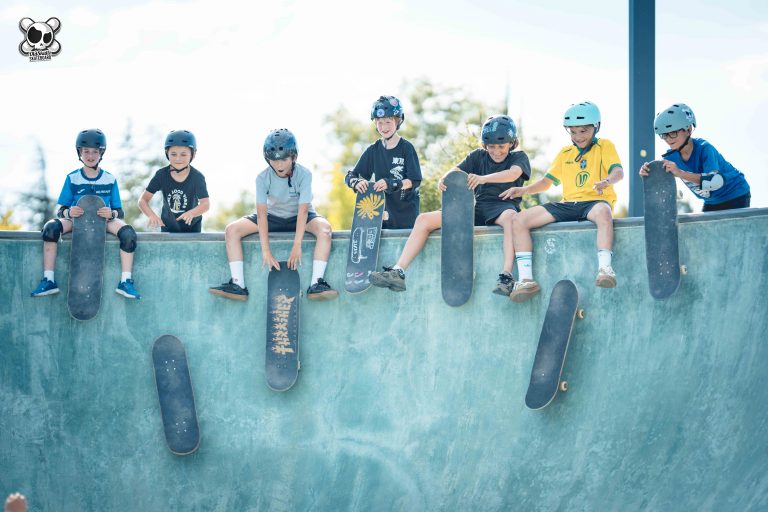
Old Skullz skaters together with their skateboards at the skatepark

The group matters too

Attempts.
Friends.
Good reasons to come back.

In group lessons or at Skate Camp, you share challenges, discoveries and small breakthroughs. We encourage one another, watch others and enjoy the session.

Tailored challengesMutual assistanceNew spotsEnjoying the ride

“You progress really quickly and never get bored!”

Join a Skate Camp

Your little progress lab.

What counts:
what changes for you.

Choose an observable criterion, such as “land and keep rolling.” Keep the exercise and criterion the same, with similar conditions, so you can compare two sets of attempts.

Baseline set
Comparison series

The calculation stays on this page. No input is sent to the server. You can save your assessment as a PDF on your device.

Your observations, your reference points

A review of your attempts,
not a grade for your skill level.

Enter the results of your two sets: the chart updates with your figures. You can adjust the number of successes with the sliders, then save your summary as a PDF.

A better success rate across two sets doesn't by itself prove lasting progress. Repeating the exercise in another session helps you see whether the cue still works.

Useful questions

Find the right setting for you.

Can we progress by skating alone?

Yes. Independent practice lets you explore and gain experience. The Academy's resources can help you structure your attempts. A coach becomes useful when you want an outside perspective, corrections or support tailored to you.

Self-guided program or online coaching: what’s the difference?

When learning independently, you follow the steps and assess your own attempts. With online coaching or video analysis, a coach can observe your skating and give you personalised feedback, depending on the package. Check what's included on the offer page.

Do I have to choose one way to practice?

You can combine them: discover a cue in the Academy, work on it with your friends, then check in with the coach. The setup can evolve with your interests, constraints and goals.

How can you keep enjoying yourself without putting pressure on yourself?

Tracking your progress is a guide, not a ranking. You can keep part of each session for free skating, vary the games and also note what you enjoyed. If a goal makes you tense, talk to your coach about adjusting the work.

Do the percentages guarantee my results?

No. The Old Skullz ranges are reported benchmarks based on experience, with no detailed measurement protocol provided on this page. Your personal tracking only calculates the success rate of the attempts you enter. Neither guarantees a result or a timeframe.

You choose the next step.

Freedom.
And good support at the right time.

A course to follow on your own, feedback on your videos or a coach at the skatepark: choose the support you need right now.

Find the right coaching
Independently

A learning path to guide you.

The Academy’s free steps and resources, to work through on your own.

Choosing My Path

Not sure yet? Talk to Max to help you choose.

Buddy IA Online

your assistant for equipment, coaching and information

Talk to Max