
The Journal · Understanding your board
Everything you need to know before choosing a skateboard deck
Behind the graphics are wood, a shape and manufacturing choices. Understand what goes into your deck so you can make an informed choice.
Start the guide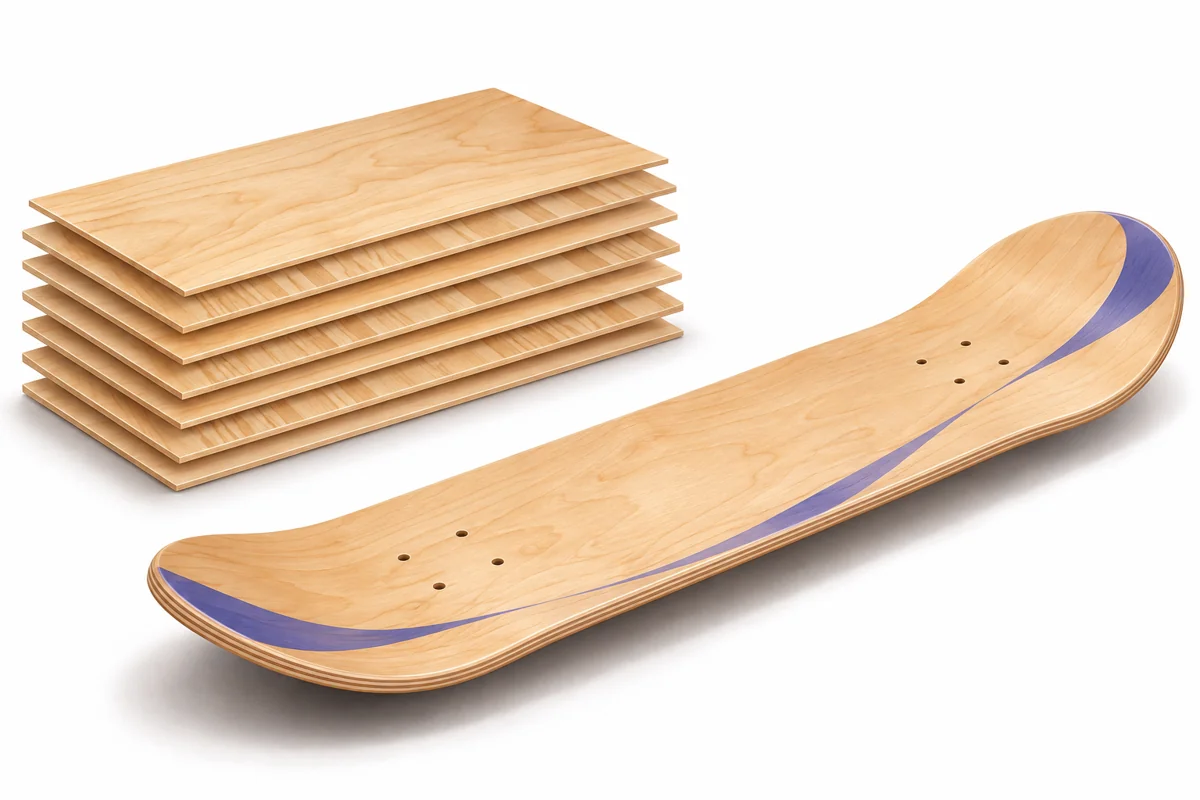
From veneer to deck
Dimensions, shape and construction
Assembly and initial guidance

Where does the wood in a skateboard deck come from? What’s a pro model? What’s the difference between a low-quality skateboard and one from a major brand that sponsors pros?
How to choose a skateboard?
When buying a skateboard deck, you're faced with countless brands and specifications, especially online. So what should you choose? What are the differences between skateboard deck brands?
Stay right here—we'll help. This article is here to make things easier. You'll understand the differences and be able to buy the skateboard that suits you.
At the bottom of the article you will find a guide to choosing your skateboard according to 4 very simple parameters. And also tips for progress if you want to learn how to skate.
You’re 2 steps away from your dream board to help you improve — let’s go!
How is a skateboard made?
Let’s start at the beginning. How are skateboard decks made? By whom? Where?
In this video, we reveal how the biggest skateboard brands make their boards. We visit the factory with 100,000 skateboards!
 The secrets of skateboard deck manufacturing revealedPlay video · Old Skullz Skateboard
The stages of making a skateboard
Making a skateboard deck involves several key stages to ensure strength, pop and durability. Here are the main steps:
1. Selection of wood
Most decks are made from Canadian maple, a durable and flexible wood.
Manufacturers choose high quality veneer sheets (usually 7 plies).
2. Gluing and pressing
Each layer is covered with epoxy glue or water-based glue to ensure a good bond.
The 7 wood plies are placed in a mould and pressed under high pressure to give the deck its concave and shape.
Drying time: about 12 to 24 hours.
3. Cutting out the shape
Once the deck is dry, it is cut using a CNC machine or a band saw.
The final shape (tail, nose, concave) is defined according to the model.
4. Sanding and finishing
The edges are sanded to avoid splintering and give a smooth touch.
The holes for the trucks are drilled accurately.
5. Screen printing and varnish
Applying the design by screen printing or thermal printing.
The deck is then coated with a protective varnish to avoid premature wear.
6. Quality control and shipping
Each board is inspected to verify that it has no defects.
They are packed and sent to skateshops or skaters.
Some brands innovate with materials such as carbon (Almost, Powell Peralta) or bamboo for greater strength.
Skate and create camps
Make your own deck and improve your skating at Skate & Create camps! (Contact us)
This week we make skateboard boards at the skatepark!
Through skateboarding, we can share 1000 ways of approaching life, creativity, having a good time, sport, and the joy of making and building…
 Make a skateboard deck at the skateparkPlay video · Old Skullz Skateboard
Children are our future. In our own way, we give them the tools to become reliable, resilient and creative people, because who knows what life will bring them.
Which skateboarding brand to choose?
As we saw in the video, all the major brands you'll find in skate shops make very good-quality skateboard decks! There's nothing to worry about. The quality is equivalent: the manufacturing process, technique and wood are the same.
The 1% difference comes down to details such as the glue used (epoxy, water-based…), the number of plies (6 or 7), and material technology such as carbon fiber in certain innovations. These can indeed play a part in the board’s strength and durability.
Brands such as Décathlon or some of those you'll find on Amazon produce lower-quality boards because they aren't specialists. You can't make camping equipment and skateboard decks with the same expertise.
If you remember just one thing, it's that all dedicated skate brands are equally good. Below you'll find a guide to the best skateboard deck brands. Choose with confidence!
Iconic and historic brands
Santa Cruz – One of the oldest brands, known for its iconic graphics
Powell Peralta – Famous for its old-school designs and legendary team
Vision – Cult brand from the 1980s, still on the market
Modern and popular brands
Primitive – Known for its stylish designs, often inspired by pop culture (collabs with Dragon Ball Z, Naruto, etc.).
Fucking Awesome – A very underground, artsy feel, often with unsettling or provocative graphics
Palace – A mix of skate and streetwear, with a huge fashion influence.
Established core skate brands
Girl & Chocolate – Two sister brands, highly respected in industry
Baker – Associated with raw style and punk skate culture
Real – High-end manufacturing and active support for skateboarders
Anti-Hero – Raw style focused on street and transition skating
Leading brands
Element – Very influential, known for its eco-responsible commitment
Plan B – Founded by professional skaters, with technical and solid designs
Almost – Founded by Rodney Mullen and Daewon Song, with innovative materials
Enjoi – Known for its humour and quirky graphics
Zero – A brand with a hardcore style, known for its videos and dedicated riders
Flip – Made history with skaters such as Tom Penny, Arto Saari and Geoff Rowley
Guide to choosing your skateboard
It's very simple, follow these 4 parameters and you'll have the skateboard of your dreams
Choosing the right board size is important to be comfortable in skateboarding! Here is a simple guide for beginners:
1. Deck sizes (width in inches):
7.5" - 8.0" ? Narrow, ideal for smaller riders or technical tricks.
8.0" - 8.25" ? Versatile, perfect for street and skatepark.
8.25" - 8.5" ? More stable, good for bowls, ramps or cruising.
8.5" and more ? Wide, recommended for transitions (ramp, bowl) and large feet.
How to choose?
Small build / shoe size below EU 40 ? 7.75" - 8.0"
Versatile / shoe sizes 40–44 ? 8.0" - 8.25"
Large feet (44+) / more stability ? 8.25" and up
If you’re starting out and want to do a bit of everything, a 8.0" or 8.125" is a good choice!
2. The shape
It is the shape of the board that influences the way it rolls and reacts under your feet. Here is a simple guide for beginners:
The main parts of the deck shape
Concave (central curvature)
Shallow (Low Concave) : More stable and comfortable, ideal for cruising and beginners.
Medium (Medium Concave) : Versatile, with a good balance between control and pop.
Pronounced (High Concave) : Responsive, perfect for technical tricks.
Nose & tail size (front & back of the board)
Longer nose : Help for tricks in fakie/nollie.
Shorter tail : Better control for ollie tricks.
General form (Outline)
Standard (popsicle) : The most common, symmetrical and versatile.
Old School (Fish, Shaped Decks) : Wider, stable, perfect for bowls or cruising.
How to choose?
Street & tricks : Medium/High Concave, Popsicle.
Versatile: medium concave, popsicle 8.0–8.25".
Cruiser / Bowl : Low Concave, Old School.
If you’re a beginner, a medium-concave popsicle shape is ideal to try everything!
3. The brand
As we saw above, choosing a dedicated skate brand is a mark of quality, durability and performance. If you're sure you want to skate and fancy treating yourself, go for it!
They cost more than low cost boards but the difference is incomparable.
The board will roll smoothly, turn well, have good pop (bounce) and stand the test of time!
4. Visual Design
The graphic is the last thing to consider: it does not change the board’s quality. But it gives you the satisfaction of having a board you like, so you’ll want to use it more. That could mean more skateboarding and, in turn, more progress!
Assembling your skateboard
Now that you know everything and have all your equipment—the deck (your skateboard's wooden board), grip tape, trucks, wheels, bearings and mounting hardware—you need to know how to put it all together. You'll see, it's very easy.
Watch the video—we explain everything step by step—and follow along with us.
 How to Assemble a Skateboard (Complete Guide)Play video · Old Skullz Skateboard
Starting well in skateboarding
Now that you have your skateboard, we'll help you progress! In this comprehensive article with videos, tips and tutorials, you'll learn basics and tricks to start skating well if you're a beginner.
 Only 1% of skaters do this... and it works!Play video · Old Skullz Skateboard
Read a deck’s product sheet without getting lost
Keep four questions in mind when comparing two models.
From one side edge to the other at the deck’s widest point.
The usual measurement between the inner rows of mounting holes.
The curve from one side edge to the other, shown in cross-section.
- What dimensions?
Width, length and wheelbase describe different things. A deck’s wheelbase is generally measured between the inner rows of truck mounting holes; check the brand’s measurement convention.
- What geometry?
Look at the concave across the deck, its overall shape, then the nose and tail. Two decks of the same width can feel different.
- What construction?
Identify the wood plies and any listed reinforcements. Reinforced construction is an option to compare based on your use, not a requirement for getting started.
- Deck only or complete skateboard?
A deck on its own normally includes neither trucks nor wheels. Check what is included, the assembly offered and compatibility with the parts you already own.
Take care of your board
Store your skateboard somewhere dry, avoid soaking the wood and regularly inspect the plies, bolt holes and ends. After an unusual impact, check your whole setup before riding again.
Changing your deck does not automatically solve a technical difficulty. If your equipment is suitable and in good condition, the ‘I work through my difficulties’ path helps you distinguish equipment, movement and how you organize your attempts.
Questions about decks
Is a pro model reserved for advanced skaters?
No. The term refers to a model associated with a professional skater's name. It doesn't, by itself, specify a required skill level: focus on width, shape, concave and construction.
Does seven-ply construction mean all decks are identical?
No. Wood, veneers, glue, pressing, dimensions and quality checks can vary. Some constructions also combine wood with fibres. The model’s product sheet tells you more than a generalization about an entire brand.
Do good-looking graphics change how a skateboard performs?
Graphics alone don’t determine how a board rides. Two boards with different graphics can share the same shape; two similar designs can have different dimensions. Compare the specifications before the graphics.
When should you replace your deck?
Watch for cracks, separating plies, areas softened by moisture and wear that compromises control. There is no lifespan that applies to everyone: how often you skate, impacts and storage make a big difference.
How can you avoid choosing based only on the brand name?
Compare the specific model: dimensions, construction, concave, intended use and manufacturer information. Price, a logo or a pro’s involvement are not enough to describe the whole setup.
Add to your reference points
The manufacturing, workshop and assembly videos come from the Old Skullz Skateboard channel. For a documented example of reinforced construction, Powell-Peralta's FLIGHT product page distinguishes the materials and dimensions of the model.
To choose your whole setup, continue with the guide to your first skateboard: size, trucks and wheels. Un terme te manque ? The skateboarding glossary is here for that.