
Your first foot placements. The right cues.
Learn to skateboard — A complete beginner’s guide
Equipment, balance, first sessions and confidence: a guide to understanding the basics, finding your bearings and progressing at your own pace.
Start the guide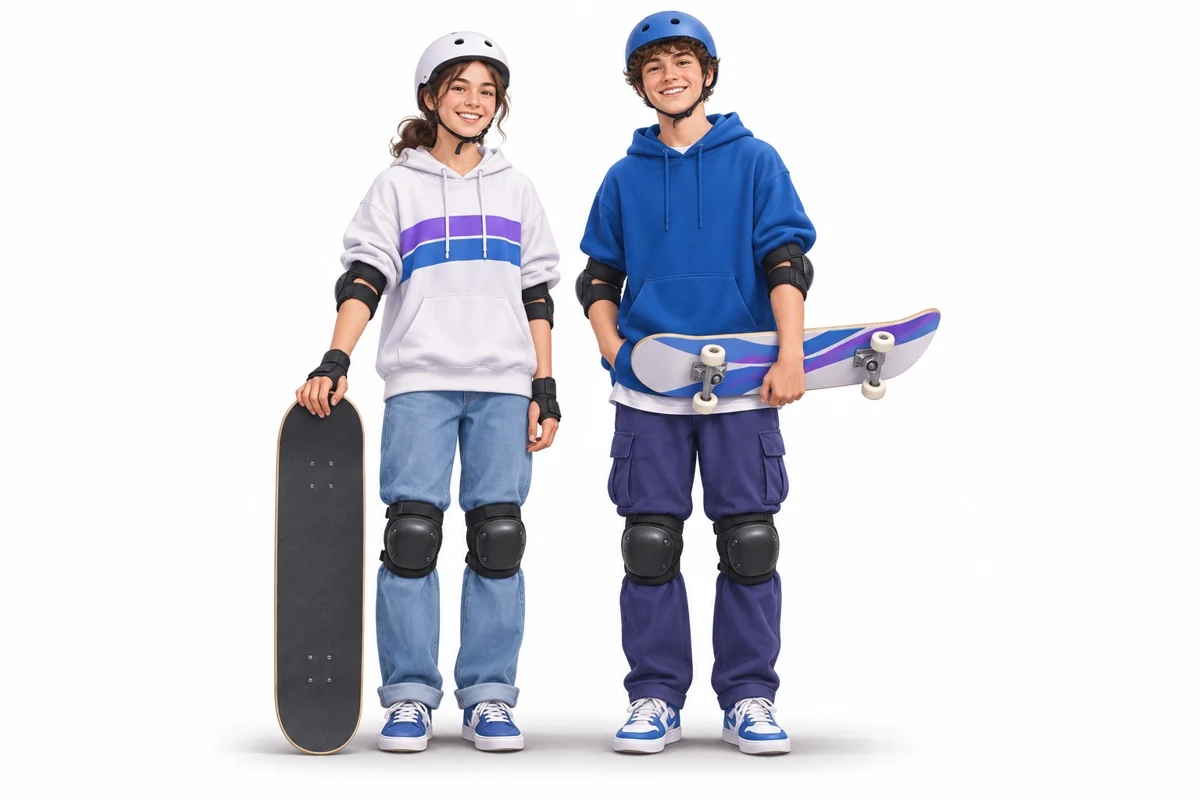
Explanations, diagrams and videos.
The exercises of the guide, easy to find.
The Academy beginner learning path and lessons.
By Maxime Cherarak, expert coach, 20 years of experience – founder of Old Skullz Skateboard
Last updated : October 2026
You wonder how learn skateboarding without getting hurt, wasting six months repeating the same mistakes or drowning in a thousand contradictory tutorials?
You’re in the right place. At Old Skullz, we’ve been supporting skaters since 2008, from their first push on a board through to competitions and the French national team. More than 6,000 people supported and 20 years of hands-on experience.
We’ve already published plenty of articles on equipment, falls, injuries, tricks and mindset. This guide brings them all together. If you read just one article on this site to learn to skateboard, make it this one. For each step, you'll find the essentials here, plus a link to an article or video that goes into more depth.
Learn skateboarding: the essentials in 30 seconds
Learning skateboarding means moving forward in this order: a adapted equipment, some protective gear and learning how to fall, the basics (stance, pushing, turning, braking), then the first trick (the ollie), all with consistency And a mind that doesn't sabotage you.
| Question | Short answer |
|---|---|
| From what age? | Around age 5–6, through play, wearing a helmet and protective gear. |
| How long to be comfortable? | Between 3 and 6 weeks to ride, turn and brake, with 2 to 3 sessions a week. |
| What about the first ollie? | Expect a few months of regular practice instead. |
| What equipment? | A standard complete skateboard (double kicktail), a helmet, protective pads and flat-soled shoes. |
| What first trick? | The ollie, after the basics and stationary jumps (hippie jumps). |
| What frequency? | 2 to 4 sessions per week from 20 to 45 minutes. |


1. Who is this guide for?
For all those who want to get on a board and enjoy it: a child who dreams of rolling like the big ones, a Teen who wants to land their first ollie, a adult who starts “late” (it’s never too late), or a parent who wants their child to progress safely.
Only thing that changes according to your age: priorities.
| Profile | What matters most |
|---|---|
| Child (5-11 years) | Play comes first. Helmet and protective pads are compulsory. Balance games (slaloming between cones, “red light/green light” on the board, balancing for 10 seconds without putting a foot down) build a positive relationship with the board. A supervised lesson is often ideal at this age. |
| Teen (12–17 years) | Channel the urge to try everything, structure their sessions and include injury prevention (core work, mobility, recovery). Skate camps suit them very well: immersion, progress and meeting people. |
| Adult (18+) | Ease back into it, work on mobility and basic strength, and accept that your progress won't follow a teenager's curve, but that it is still real. Shorter, regular sessions, a thorough warm-up, and enjoyment before performance. |
Skating is for you if you’re willing to progress in small steps, taking a few manageable tumbles and preferring a sport that gives you freedom, without a judge watching all the time. It suits you less (for now) if you want results in three days or if you can't bear even the idea of failing. In that case, chapter 10 is for you.
2. Why skateboarding: what nobody really explains to you
Physical: a complete sport hidden in a board
- Balance and coordination : every tiny adjustment to stay upright is a mini neuromuscular workout.
- Strength and explosiveness : legs, abs, back, ankles, especially from the first jumps.
- Endurance : you push, walk and try again. A session combines cardio with explosive repetitions.
- Mobility and proprioception : your body learns to sense its position in space and handle uneven surfaces.
For a child, it's a laboratory for developing motor skills. For an adult, a fun remedy for a sedentary lifestyle.
Mindset: a school of perseverance (and useful falls)
Skateboarding makes you accept repeated failure — missing a trick thirty times before landing it perfectly — manage fear of speed, falling or others’ judgement, and stay focused: think about something else for three seconds and you hit the pavement. And you can measure your progress: yesterday you couldn’t get off the ground; today you land it.
Social: an individual sport but never alone
You arrive at an unfamiliar skatepark, pop a good ollie, and you're part of the scene. Whatever your level, if you try, you'll be encouraged. And you become part of a culture: music, videos, travel and spots.
Another way of see skateboarding
- Motivation
- Sport
- Fun
 Another way to see skateboardingPlay video · Old Skullz Skateboard
3. Choose the right beginner skateboard (without falling into the traps)
A good skateboard is like a good pair of running shoes: choose badly, and everything gets harder.
The board: width and quality
To get started in street / skatepark, we recommend:
| Profile | Indicative age | Board width |
|---|---|---|
| Child | 5-9 years | 7.8″ to 8.0″ |
| Pre-Adolescent / Teen | 10 to 14 years old | 7.8″ to 8.125″ |
| Teen/adult | depending on your build and style | 8.125″ to 9.0″ |
The more the board is wide, the more stable it is (helpful for beginners), though a little less manoeuvrable for some tricks. Avoid “toy” boards from supermarkets and big-box stores: ultra-light and made from poor-quality wood, they split, vibrate and slow your progress.
A coach’s reflections on experience: Over the years, we have stopped recommending small sizes (7.2″ to 7.75″), even for the youngest riders. They have become rare in skateshops, and above all, the earlier you get used to a standard-sized board, the more you improve your balance: it makes you ride with your feet apart, which is great for progressing quickly.
Trucks, wheels and bearings: the underrated trio
- Trucks : choose a size that matches your board's width. Trucks that are too narrow or too wide make it harder to stay stable when starting out.
- Wheels : 52 to 54 mm for street and skateparks; 99A to 101A hardness on smooth surfaces, a little softer (90 to 95A) if you often skate around town.
- Bearings : you do not need top-of-the-range bearings. Decent ABEC 5 or 7 bearings are more than enough to start.
How to assemble your skateboard
- Assembly
- Grip tape
- Wheel and bearings
 How to assemble your skateboardPlay video · Old Skullz Skateboard
Shoes and protective gear
Shoes with flat sole designed for skateboarding: heavily cushioned running shoes make board contact less precise. We'll return to protective gear (helmet, knee pads, elbow pads and wrist guards) in the next chapter, because its role is more subtle than it seems.
For more guidance on buying: our guide to choose your skateboard.
4. Learning to Fall (before learning to jump)
The truth: you're going to fall. The good news: you can learn to fall better.
Basic rules
- Don’t try to catch yourself with your arms stretched out in front. It's the best way to hurt your wrists.
- Roll or slide instead of coming to an abrupt stop : knee pads let you control a slide on smooth ground. If you fall, cushion the impact with your forearms rather than your hands.
- Look ahead, not your feet.
- Don’t skate when you’re exhausted. You get hurt faster.
Protective gear: useful for confidence, but don't rely on it alone
A helmet, knee pads, elbow pads and wrist guards are recommended when starting out, above all for children, teenagers and adults returning to skating. They aren’t there to “make you look like a beginner”: they expand your comfort zone and let you experiment more freely.
But they don’t replace the movement. The aim is for you to know catch yourself even without protective gear, so you don't depend on the equipment. That's why we practise falling separately, in a controlled way: dropping onto padded knees, sliding, rolling and getting up quickly.
The detailed exercises are in start skating safely and comprehensive prevention in our skateboard injury guide.
To go further:
The protective gear in skateboarding
- Obstacles
- Protective gear
- Method
 Protective gear for skateboardingPlay video · Old Skullz Skateboard
-> Bonus video: Learn skateboarding without hurting yourself.
5. The technical bases to master before tricks
Before you talk ollie and kickflip, you need a solid base.
Find your stance: regular or goofy
-
Regular : left foot in front
-
Goofy : right foot in front
A quick, simple test:
-
Ask someone to give you a gentle push on the back.
-
The foot you instinctively put forward to catch yourself is often The one who goes in front.
Regular
Left foot in front
Top view · arrow indicates frontGoofy
Right foot in front
Top view · arrow indicates frontNeither stance is better: what matters is what feels natural to you.
Go up and down with control
Goal: step onto the board without it rolling away. Put it on a surface that isn’t too slippery (firm grass, a mat or sports flooring), then first place your front foot over the front bolts, gently shift your weight, then place your back foot. Step off in reverse order. Repeat until it becomes automatic.
Pushing and rolling
Front foot on the board (sideways, over the front bolts), back foot on the ground pushing gently, then bring your back foot onto the board. Goal: roll 10 to 15 metres without panicking.
Frequent error: the "mongo push" (pushing with your front foot). It isn't forbidden, but it's less stable and less efficient. Correct it early before the habit takes hold.
Turning: by shifting your weight, not by force
Two ways: carving (you slightly incline the body and board by pressing on the toes or heels, the trucks rotate) and the small pivot (at low speed, take a little weight off your front wheels).
Brake without panicking
- Foot braking : gently take your back foot off the board and let it drag along the ground.
- Wide carving turns : Large turns reduce speed.
- Leaving your line : aim for a flat area with no obstacles.
The golden rule when starting out: never choose a slope you don’t know how to brake on.
Another way to learn skateboarding
- Professional advice
- Every day
- In a group or on your own
 Another way to learn skateboardingPlay video · Old Skullz Skateboard
The exercise: your first 10-minute session
Duration: 10 minutes, on flat, smooth ground, with no slope, wearing your protective gear.
- Warm up (2 min) : brisk walking, ankle, knee, hip and wrist rotations.
- Step on and off of the stationary board, front foot over the front bolts, 5 times on each side.
- Push twice, place both feet on the board and let it roll. Count how many meters you cover.
- Lean to turn : shift your weight onto your toes, then your heels, to make wide turns.
- Brake with your foot : back foot on the ground, gently dragging the sole until you stop.
- Write down a win and stop on a success, not on a failure.
Practical example : you’re in a flat parking lot. You step onto the stationary board 5 times, then push twice and roll 6 meters. You write down 6. You try again, aiming for 8, brake with your foot and finish there. Next session, aim for 10 meters without putting your foot down.
6. Where to skate when you start
Choose a surface smooth, clean and dry, free of gravel and cracks, with no traffic. An empty car park, a sports surface or a quiet skatepark works well for your first sessions. Avoid damaged, wet or sloping ground.
At the skatepark, a few good etiquette habits help you get along with everyone: watch before entering, don't cut across other riders' lines, don't stand at the bottom of an obstacle, wait your turn and don't compare yourself to others. Most riders are too busy working on their own tricks to watch yours.
All the details, including how to get started without “feeling out of place”: New to the skatepark: how to get started without struggling.
7. First tricks: the ollie and what comes next
The ollie is the foundation for most other tricks. But it takes preparation: before popping, you learn to lift the board with your body.
Learn the ollie step by step
- Start by lifting the board : practice your jumps with the board stationary.
- Have fun with hippie jumps : jump and lift your knees, without a board, to coordinate your arms and legs.
- Place your back foot : toes centered on the tail.
- Do another hippie jump with the ball of your foot on the tail.
- Add the pop : pop is a sharp, quick snap of the tail against the ground. You should hear it.
- Slide your front foot towards the nose to level out the board, then bend your knees on landing.
Coach's "cheat code": start straightening your legs before to pop. And don't worry if your first ollie is tiny: that's normal.
To go further, here are two small useful resources:
– 5 foot positions depending on the trick
– How to learn the ollie
And if you can’t land the ollie: why you’re not landing your tricks details the most frequent errors.
Tricks accessible without ollie
The manual is an excellent balance exercise that doesn't require leaving the ground. It helps you work on your centre of gravity and board control, two skills that support everything else.
The recommended order for the next steps
Once you have learnt the ollie, this is the order we follow in lessons, detailed in learn to skateboard: basics and tricks for beginners : ollie → pop shove-it → fakie ollie → frontside 180 → kickflip → heelflip → nollie → 360 shove-it → 360 flip.
For the pop shove-it, three pointers: position your feet correctly, let your toes hang over the tail, and start with a board without wheels to practise catching it with your front foot. For the kickflip, the full tutorial is here.
If you'd rather learn by watching:
– Learn pop shove-it
– Learn Kickflip
Choose 1 or 2 tricks maximum per session. Working five tricks at a time prevents your brain from consolidating them.


8. The 30-day “zero → comfortable on your board” programme
A practical one-month plan, adapted to your pace. Allow 3 to 4 sessions per week, lasting 20 to 30 minutes.
| Week | Objectives and exercises |
|---|---|
| Week 1Get comfortable with the board | Know your stance, get on and off the board comfortably, and roll 10 metres on flatground. Sample session: 5 minutes of warm-up (ankles, knees, hips, wrists), 10 minutes of getting on and off the board, changing stance and making small jumps on the spot, then 10 to 15 minutes of gentle pushing, rolling and foot braking. |
| Week 2Rolling, turning, controlling speed | Roll for 20 to 30 metres, make wide turns and brake whenever you choose. Add carving exercises (weight on heels/toes), very easy gentle descents and sequences of “push, brake, set off again”. |
| Week 3Terrain and skatepark | Ride over small changes in terrain (a gentle slope, a bump), try new surfaces and feel comfortable at the skatepark. Examples: a small transition or bank (without dropping in), a pavement joint, getting used to other riders being around. |
| Week 4First jumps and control | Start jumping with the board and improve your pop, without aiming for the perfect ollie. Hippie jumps, jumps with the board stationary on grass or a mat, and practising the back-foot pop without trying for height. |
-> For structured follow-up, the Old Skullz online coaching adapt this plan to your level, with video feedback.
9. Warm-ups, mobility and injuries
Especially in adults, warming up is not optional : neither do your ankles. Five minutes working on ankles, knees, hips and wrists before each session already makes a real difference.
To go further, the 13-minute skater mobility session is designed for that.
A few principles apply at any age: don't skate when you're exhausted, take a break after a bad fall instead of trying again and again, and seek medical advice if pain persists.
Skateboarding injuries often have recurring causes that can be prevented: once again, it all comes down to our skateboard injury guide.
10. Mindset: fear of falling, feeling useless, daring to try again
We said "learn to fall" in chapter 4, but the real fall often happens in the head. Do you recognize any of these situations?
- You are at the edge of a small step, you know exactly what to do, and your stomach tightens. You back out at the last second.
- You've failed the same trick ten times in front of strangers, and you tell yourself you don't belong there.
- You took a hard fall three weeks ago. Your board has stayed in the corner, and the more you think about it, the less you feel like going back.
These three situations say nothing about your skill level. They say that Your brain is doing its job.. Voyons comment il fonctionne, et ce qu’on peut en faire.
The three fears we see most in coaching
- Fear of pain : “I’m going to hurt myself.” A legitimate fear, especially after a bad fall.
- Fear of ridicule : “I’m going to mess up in front of everyone.” Very common among teenagers and adults who start later in life.
- Fear of repeated failure : “I’m going to fail again.” When a trick stays out of reach for a long time, frustration builds up and the fear of trying again grows.
Faced with a perceived risk, your body prepares itself: tense muscles, shallow breathing, heightened attention. It’s useful when there’s real danger, but a kickflip can trigger it too.
The result: you freeze, overthink and disrupt a movement your body knew how to do. The more you fail in this state, the more your brain associates the trick with danger. A vicious circle develops.
For details of the mechanism: fear of falling when skating: regain your confidence.
After a fall: why calling yourself useless doesn’t work
In skating, you're often told to “snap out of it” and try again straight away. It sounds motivating, but research suggests the opposite. In four experiments, psychologists Juliana Breines and Serena Chen showed that people encouraged to treat their failure with kindness rather than harshness were more motivated to improve, no less (Breines & Chen, 2012). A coach's perspective: when you beat yourself up, you tend to look away from failure; when you treat yourself kindly, you can face it and learn something from it.
Another factor: after a painful fall, your brain stores a broad prediction (“if I repeat this movement, I'll get hurt”). The review by Michelle Craske and colleagues on exposure therapy indicates that fear decreases most when experience contradicts what the brain expected: you face the situation and discover that the feared outcome doesn't happen (Craske et al., 2014). An honest clarification: this research concerns laboratory studies and treatment for anxiety disorders, not skateboarding. It offers a way to understand things, not a promise.
In practice, here's how we apply it in coaching: neither put the board away for a month nor try again at full speed in front of your friends. Take a easier version of the same gesture, land it several times, then move up a level. The article after a bad fall, being hard on yourself doesn't help you details this method in two stages.
6 coaching habits to help you progress despite fear
- Name the fear rather than fighting it: “I am afraid of this ramp.” Putting it into words helps you regain control.
- Break the trick down into tiny steps, and work in the learning zone: just beyond your comfort zone, never in panic.
- Learn to Fall : fear decreases sharply when you know how to fall.
- Visualise landing the trick for 30 seconds before trying, or three seconds just before the attempt. Not the failed attempt. To go further: our guide to skate visualization.
- Breathe : breathe in for 4 seconds, breathe out for 6 seconds, three to five times.
- Stop on a success, even a partial one. A short, positive session is better than a long, frustrating one.
And if you skate better alone than in front of others, that's common: build up gradually, first with a trusted friend, then a small group, then a busy skatepark. You'll find more advice on the mental side in our article on progress and in the 5 truths about getting started.
The 7 mistakes that slow beginners down
- Skipping steps : wanting to ollie before you can ride properly.
- Skating without a goal : arriving at the skatepark, wandering around for an hour, leaving frustrated.
- Terrible equipment : a toy board, plastic wheels, squeaky trucks. Everything is harder.
- No warm-up : especially in adults.
- Comparing yourself to others : you don’t know how many hours they’ve practised.
- Not filming yourself : the video shows what you actually do, not what you think you do.
- Always skating alone, without outside feedback : you can repeat the same mistake for months.
To learn while having fun rather than putting pressure on yourself, also read learning while having fun boosts your skateboarding progress.
11. Learning alone, with friends or with a coach?
@media (max-width: 600px) {
.os-table, .os-table tbody, .os-table tr, .os-table th, .os-table td { display: block; width: 100%; }
.os-table thead { display: none; }
.os-table tbody th { width: 100%; border-top: 1px solid #c9d8e8; padding: 12px 16px 6px; }
.os-table tbody td { padding: 4px 16px; border-top: none; }
.os-table tbody td:last-child { padding-bottom: 14px; }
.os-table tbody tr:nth-child(even) td { background: #ffffff; }
.os-table td[data-label]::before { content: attr(data-label) " : "; font-weight: 700; color: #16478a; }
}
| Option | Benefits | Limits |
|---|---|---|
| Alone, with YouTube | Free, flexible, you skate whenever you want. | Risk of ingraining bad habits, sometimes slow progress and no one to correct your technique. |
| With more advanced friends | Motivation, ambiance, live advice. | Their explanations are not necessarily easy to learn from, and they do not have your body, your mindset or your skill level. |
| With a coach and a method | Structured progression, immediate corrections, management of fears and blockages. | Cost, offset by time saved, fewer unnecessary falls and sometimes fewer injuries. |
At Old Skullz, we combine fun, technique and mindset. Depending on your situation:
- Year-round skate lessons and the club, to skate in real life with a coach and a group.
- The Skate Camps, for an immersive week of skating and progress during the holidays.
- Online coaching, to progress from anywhere with a plan, ongoing support and video feedback.
- Video analysis of your trick, if you want precise outside insight into a block.
You don't have to be ready to start. Just start to be ready.
Your action plan: the next 5 steps
- Choose your equipment : a decent skateboard, protective gear and flat-soled shoes.
- Set aside 2 to 4 time slots per week 20 to 45 minutes.
- Work on the basics : get on / get off, roll, turn, brake, fall.
- Track your progress : distance covered, fears overcome, new sensations.
- If you want to go faster, find a structured setting: lessons, a camp or coaching.
Choose a day this week for your first real session and set a specific goal: “roll 10 metres without putting a foot down”, “make three clean turns”, “dare to step onto the board”. The rest is you and your board… and everything that comes next.
Skateboard lessons & Club
Rise and Grind online coaching
Skate Camps
FAQ: Learn skateboarding when you start (parents, children, teens, adults)
At what age can you start skateboarding?
How long does it take to be comfortable on a board?
What is the first trick to learn in skateboarding?
How do you learn to fall when skateboarding?
Should beginners wear protective gear?
How can you stop being afraid of falling when skateboarding?
Is it better to start with a longboard, cruiser or classic skateboard?
Is skateboarding dangerous for children?
How can I tell if I need a coach, or if my child or teenager does?
I'm an adult, isn't it too late to start skating?
Skateboarding as tool for life, Not just a hobby.
Learning skateboarding is not just about standing on a board:
it means learning to fall and get up,
it's accepting to be a beginner,
means becoming part of a culture, a mindset: progression, creativity, mutual assistance.
Progressing in skateboarding with method

Skateboard lessons
Further informationSkate lessons in and around Avignon. Learn, progress and push your limits. At any age.
Further information
Online coaching
DiscoverOnline coaching. Want to progress at your own pace, wherever you are? We support you with a clear plan and an outside perspective.
Discover
Courses and Skate Camps
See the datesAn immersive week to learn as much about yourself as about your skating.
See the dates