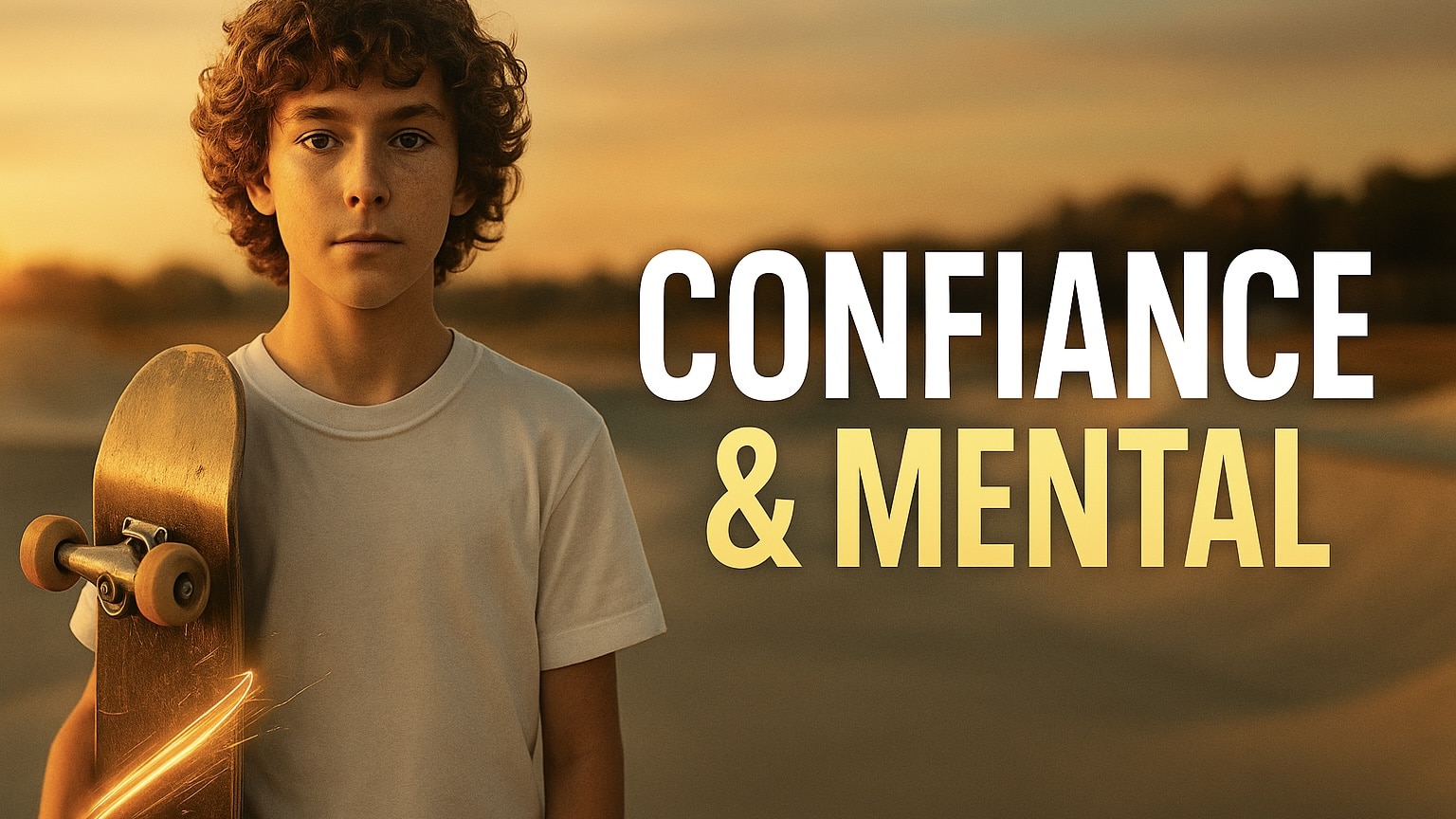
Fear of getting injured when returning to skating skateboarding at 35 : what no one has explained to you
The complete guide to returning with confidence and without injury, even after years away.
Skatepark, 2:32 p.m., board under foot, trick in mind, you know exactly what to do.
But something's holding you back. A hesitation, a cramp in your stomach, a little voice whispering: What if I fall?
Every rider knows this fear, from beginners to intermediates. Even the pros—they’ve just learned to work with it.
After over 18 years coaching skaters of all levels at Old Skullz, I can tell you one thing for sure: Fear of falling is not your enemy.
It's a signal. And like any signal, you learn to read it, to understand it and to overcome it.
In this guide, you will understand how it works The psychology of fear and the brain mechanisms that block your tricks.
I'll also give you the practical tools I use in coaching, structured into steps you can use from your very next session.


Why you're afraid to fall ? (that's perfectly normal)
What your brain does when you get on a board.
Being afraid of falling while skating isn't a weakness. Your brain is doing exactly what it's meant to do.
When you perceive a risk—a ramp, a new trick, an unfamiliar surface—a small part of your brain called theamygdala triggers an alarm.
Within milliseconds, your body gets ready: tense muscles, shallow breathing, full alertness.
The problem is that this response is designed for real, immediate dangers. Your amygdala can’t tell the difference between a predator and a kickflip.
The result : you freeze, overthink and abandon the trick at the last second.
And the more you fail in this a state of stress, the more your brain associates this trick with a danger and a a vicious circle develops.
Muscle memory: your misunderstood ally
Skateboarding relies heavily on Muscle memory, this ability of your body to reproduce a movement without your conscious brain having to pilot everything.
When you start out, everything is conscious and slow. With repetition, the movement descends into deeper areas of the brain to become automatic and fluid.
Fear short-circuits this process. Elle ramène tout en “mode conscient”, hyper-contrôlé. Et le contrôle excessif casse le flow.
Understanding the mechanism is the first step towards breaking free of it.
Fear is not in your feet, nor on your board.
It’s in your head, and that’s something you can work on.
The 3 types of fear I see most in coaching
-> Fear of physical pain : “I'm going to hurt myself.” A legitimate fear, especially if you've had bad falls before. The body remembers past pain.
-> Fear of ridicule : “I’m going to mess up in front of everyone.” Very common among teenagers, but also among adults who take up skating later in life.
-> Fear of repeated failure : “I'm going to miss it again.” When a trick stays out of reach for a long time, frustration builds and the fear of trying again grows with each attempt.
The 5 steps to progress without burning yourself out mentally
What I've learned over the years is that we don't overcome fear at once.
We work through it in stages.
Here's the path I guide my riders along, whether they're beginners or intermediate skaters.
Besides, if you're a beginner, don't hesitate to go read our complete guide to learn skateboarding, you'll find all the resources to get started safely and progress quickly.
Step 1 – Accept fear (instead of fighting it)
It's the first reflex when you're afraid: try not to be afraid. Plus tu résistes à une émotion, plus elle prend de la place.
What I'm teaching first and foremost isacceptance.
In practice, when you feel apprehension building before a trick, name it: “I am afraid of this ramp.”
Simply putting it into words activates the prefrontal cortex, the rational part of your brain, and mechanically reduces activity in the amygdala.
Try it during your next session!
Step 2 – Break down the trick (the logical progression)
The classic mistake is tackling a difficult trick head-on, all at once. The right method is breakdown.
Every complex trick is a sequence of small movements that can be practised separately.
Let us take the example of kickflip (if you want the full tutorial, it’s right here!): first, foot placement while stationary; then the pop; then the ankle flick without jumping, followed by adding a jump, and finally the full trick.
With every successful small step, your brain records a win. Confidence grows and fear recedes.
The 3-zone rule
With my riders, I always work on 3 areas: the comfort zone (what they master), the learning area (slightly above) and the panic zone (too difficult).
-> All progress is made in the middle area, never in panic.
Step 3 – Fall correctly (yes, you can learn how)
The fear of falling decreases drastically when you know how to fall.
In my lessons, we spend time practising controlled falls: how to roll on the ground, absorb the impact with your forearms and let yourself slide rather than brace rigidly.
That's also why protective gear matters: not to “look like a beginner”, but to expand your comfort zone and let you experiment more freely.
A skater wearing protective gear takes more calculated risks and progresses faster.
Step 4 – Using Visualization
Top-level athletes do this systematically. The visualization, it means mentally rehearsing a movement before performing it physically.
From a neural perspective, the brain sees almost no difference between an intensely imagined movement and a real one.
Before attempting a trick that intimidates you, close your eyes for 30 seconds. Visualise each phase: the pop, the flight, the landing and the roll-away. Feel the movement in your body. When you open your eyes, your brain has “already done” the trick once.
The unknown is less unknown.
To explore visualisation further, here is full article to understand all the rules.
Step 5 – Repeat in a state of calm (not stress)
The repetition reinforces movements in muscle memory. But the quality of your mental state during repetition matters as much as the number of attempts.
Repeating a trick in panic reinforces the panic as much as the movement.
The aim is to find the good activation level. Ni trop détendu (pas d’élan), ni trop stressé (paralysie). Ce que les sportifs appellent le “flow” ou la “zone”.
It is cultivated in different ways: adapted music, pre-session ritual, breathing or familiar environment for new tricks.
It's your turn to find yours!
If you're not sure how to do it, we can work through it together.
The practical techniques that I use with my riders
Here's what really happens in an Old Skullz session when fear holds a rider back.
The technique of progressive engagement
I never ask a rider to “jump in at the deep end.” We increase the intensity in small steps. If a rider is afraid of a step, we start on flat ground. Then a tiny step, then the step itself. Then two steps.
What matters, It is that each level is experienced as a success, not like a painful effort.
This principle is called the progressive desensitisation. Il est utilisé en psychologie sportive depuis des décennies. Appliqué au skate, il est redoutablement efficace.
The “what if it goes well?” technique
Skaters who feel stuck tend to imagine the worst: falling, pain and embarrassment.
I turn the question back to them: “What if it goes well? Describe how you imagine the perfect landing.” This simple change of focus shifts your attention towards possible success rather than probable failure.
It isn’t “magical thinking”. It’s attention regulation and that can be guided.
The positive debriefing technique
After every lesson, we take 5 minutes to identify what went well, even if the session was difficult.
A rider who remembers only their failures will progress half as fast as a rider who reinforces their successes.
The brain learns through reinforcement. Give it positive things to take in.
Breathing as a performance tool
When anxiety rises, short, rapid breathing feeds it. The opposite is also true, A slow, deep breath sends the brain the signal that everything is fine.
A simple technique before a difficult trick: breathe in for 4 seconds and out for 6 seconds. Repeat 3 to 5 times. Your nervous system regulates itself.
What I tell all my riders who feel stuck
“Fear rarely disappears before the trick. It disappears during or just afterwards. You don't wait to feel brave before acting. You act, and courage comes through action.”
The errors that keep fear going (and how to avoid them)
-> Forcing a trick when you’re tired or stressed. Physical and mental fatigue amplifies fear and the real risk of falling. It is better to have a short and positive session than a long frustrating session.
-> Comparing your progress with other people’s. Chaque profil est différent, chacun apprend à son rythme. La comparaison génère une pression supplémentaire qui nourrit l’anxiété.
At Old Skullz, we know each rider’s profile and build a progression that suits them. A method that doesn’t adapt to the person isn’t a method—it’s a mold.
-> Making attempt after attempt without calming down. Après une mauvaise chute ou un trick raté en série, faire une pause n’est pas une faiblesse. C’est de la stratégie.
-> Ignore your body's signals. Douleur, fatigue intense, appréhension qui ne passe pas; ton corps te parle. Apprendre à l’écouter est une compétence et non une capitulation.
-> Skating alone when you’re stuck. La présence d’un coach ou même d’un rider expérimenté change tout. Être observé par quelqu’un de bienveillant réduit la pression et améliore la performance. Avec le coaching en ligne Old Skullz, tu n’es plus seul face à ton blocage : j’analyse ta vidéo, identifie ce qui coince et te donne un plan de correction précis.
Beginner or intermediate : what changes (and what does not change)
For beginners
Fear is strongest at first because everything is unfamiliar: the moving board, unpredictable falls and the feeling of losing control completely.
The main goal is to createpositive and repeated experience on simple situations.
We're not trying to go fast, we're trying to build a a relationship of trust with your board.
The three absolute priorities at the start:
-> Learning to Fall
-> Mastering balance during movement
-> Build up small wins
Technical progress will naturally come if the emotional basis is solid.
For intermediate skaters
At this point, fear takes a different form. We no longer fear the board. We fear the specific trick, the higher level, regression.
It's the fear of plateauing, of stagnation. Elle est souvent aggravée par l’ego : “Je devrais déjà savoir faire ça.”
What helps:
-> Return to the fundamentals with fresh eyes
-> Vary your skating environments to break the mental routine
-> Work on your mindset as much as your technique
This is often where a coach’s support makes the biggest difference.
Word of the coach
“At each level, fear takes a different form. But the remedy stays the same: understand, break it down, repeat calmly and celebrate every bit of progress, however tiny.”
The course that makes you rich... in confidence and mindset
Want to reach the next level ?
This is the guide I wish I'd read when I started. Before the injuries and doubts, before learning the hard way that the mental side matters as much as technique—perhaps more.
At Old Skullz, we teach more than tricks. We teach you to skate with your head as much as your feet. From the start, our method has integrated the technical, mental and emotional sides of progression.
Because skateboarding is a tool for discovery and self-confidence, not just a sport.
If you recognize yourself in what you just read, if you've been stuck on a trick for weeks, if you feel a fear that's holding you back, if you want to progress fast and better, the next step is to be accompanied.
Join us!
Skate lessons in and around Avignon. Learn, progress and push your limits. At any age.
Online coaching. Want to progress at your own pace, wherever you are? We support you with a clear plan and an outside perspective.
An immersive week to learn as much about yourself as about your skating.
You don't need to be ready to start.
You just need to start to be ready.
See you soon,
Team Old Skullz


