

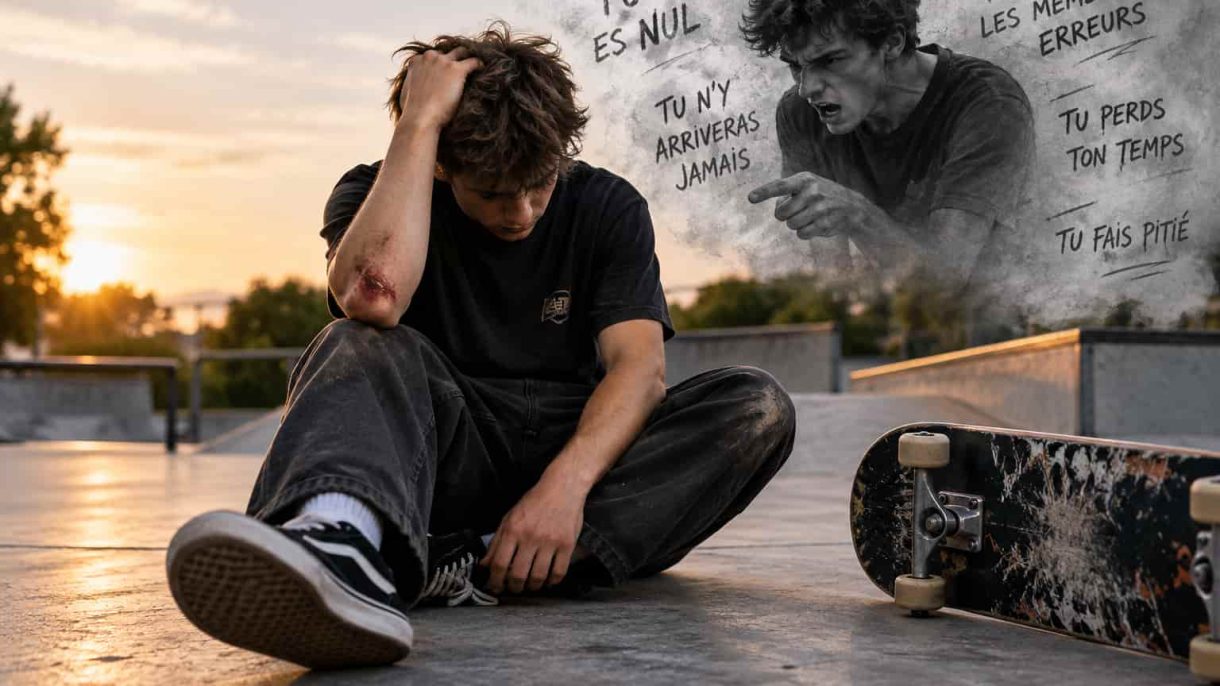
“Snap out of it.” “It's nothing, get up.” “Stop complaining and try again.”
If you've been skating for a while, you've heard a version of those phrases or you've told yourself after a fall that hurt your ego more than your body.
It's part of skate culture: take the hit, don't complain, get back on the board. The problem is that this method of recovering mentally after a fall doesn't work as well as we think, and science explains exactly why.
Also read → afraid of falling while skating: regain your confidence.
And if you’re just starting out, I recommend first reading our complete guide to learn skateboarding.
What we mean by “getting back up” mentally
Two separate things happen after a bad fall: the little voice that judges you (“you're useless”, “you shouldn't have tried that”), and the physical fear of repeating the movement that made you fall.
Getting back on your feet mentally isn’t about making either one disappear through sheer willpower. It means changing how you deal with both, so you can try again without waiting three weeks to “process” it all.
What science says in part 1: self-criticism does not motivate, it paralyses
The common belief is that you have to be hard on yourself to improve, and that being kind to yourself is for people who don't really want to succeed.
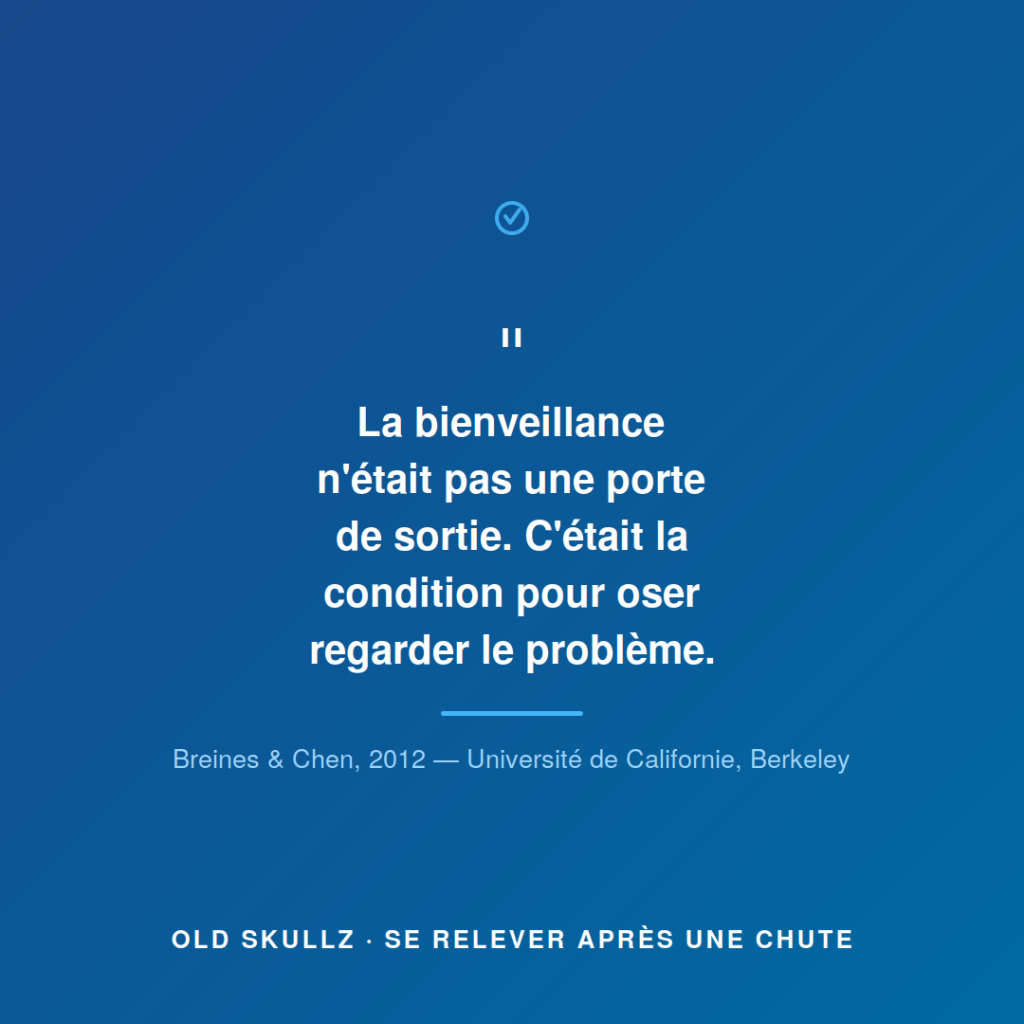
A series of four experiments conducted by psychologists Juliana Breines and Serena Chen (University of California, Berkeley) tested this belief directly. Participants who were encouraged to respond to their own failure with self-compassion, rather than harshness or simple reassurance about their self-esteem, subsequently showed more motivated to work on their weaknesses, not less (Breines & Chen, 2012).
The mechanism proposed by the authors is simple: being harsh on yourself makes you avoid facing failure because it's painful.
Kindness, by contrast, creates enough safety to examine it honestly and learn from it. In skatepark language: calling yourself useless after a fall doesn’t make you want to try again. It just makes you want to put your board away.
“Yeah, but if I am too kind to myself, I will stop giving it my all.”
That's exactly the myth the study debunks. Being kind to yourself after a failure has nothing to do with making excuses or lowering your standards.
The participants in the study who were kindest to themselves were also those who then spent the most time actively working on what had gone wrong. Self-compassion wasn't a way out. It was what allowed them to face the problem.
What science says, part 2: why you're afraid to repeat THAT specific movement
After a painful fall, your brain doesn’t remember “I missed that trick.” It retains a much broader and more catastrophic prediction: “If I do that movement again, I’ll get hurt again.”
This is exactly the mechanism that exposure therapy researchers have been studying for decades to treat fears and phobias. A major review of the subject, published by Michelle Craske and his team (UCLA) in Behaviour Research and Therapy (Craske, Treanor, Conway, Zbozinek & Vervliet, 2014), shows that fear decreases in the long term when we allow this catastrophic prediction to be disprove through experience, in a progressive and controlled way, not by avoiding the situation, and not either by rushing into it at full speed to "prove that we are not afraid".
A quick clarification: Craske’s study was not conducted with athletes, but with people working on phobias and anxiety disorders in therapy. The mechanism it demonstrates — fear receding when experience directly contradicts what was feared — is a general principle of the brain, not a technique invented for sport. There is no guarantee it applies in exactly the same way at a skatepark as in a psychologist’s office. But the logic is the same, and it closely matches what we observe when a skater tries a trick again after a fall.
The two strategies that miss the mark after a fall
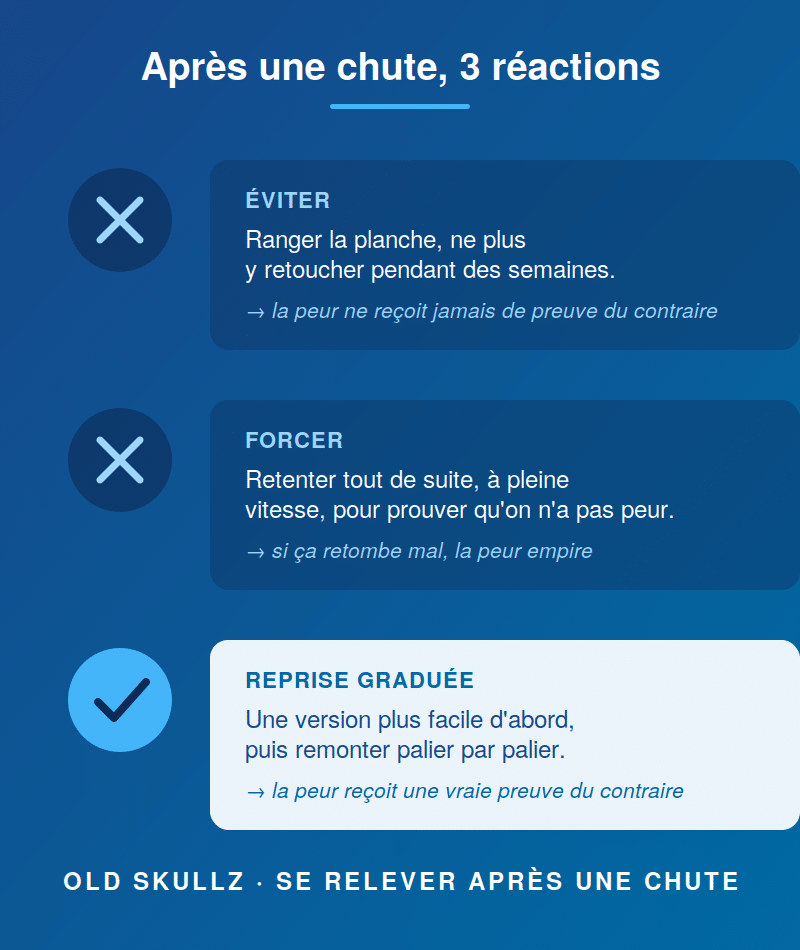
- Putting the board away for a month (the fear never gets evidence to the contrary, so it stays intact).
- Immediately trying the same trick again at the same speed to look brave in front of your friends (if you land badly a second time, the catastrophic prediction is confirmed and the fear gets worse).
What works is the intermediate step: an easier version of the same movement that proves to your brain—not just through reassuring words—that things can go well.
What this changes in practice
Together, these two mechanisms suggest a method that is the opposite of the instinct to tell yourself to “snap out of it”: first, respond to failure with enough self-compassion to avoid fleeing the situation; then test your physical fear again in stages, rather than all at once.
I can speak from what my own body has been through. Every injury means a year off. And every time I return, fear is there at every stage. It starts with something really simple: I gently step off my stationary board, and the question is already there — can my knee even handle that? Once I've passed that first step, the next one comes: will it hold up if I pop an ollie? Every stage brings its own moment of doubt, and there's only one way to resolve it: try it in a real situation, sometimes controlled, sometimes not, until the body proves it can be trusted again.
What helped me wasn't forcing it. It was taking it step by step and starting again with the basics: relearning how to push and ride, rebuilding muscle and, above all, relearning to trust my joints before relearning tricks. Even today, the fear and vulnerability are still there somewhere. That's exactly why I keep looking after my body regularly, not just to progress but to stay strong.
These injuries forced me to relearn a sport I already knew, not from scratch but more intelligently: following a staged plan, working on attention as much as intention, and accepting the climb back up without skipping steps. That physical and mental rehabilitation is what I now share with the skaters and other athletes I support.
Neither step asks you to “look on the bright side” or downplay the fall. Both simply ask you not to treat it as a final judgment on you as a skater.
To learn more about injuries, you can read our article skateboard injuries: complete guide.
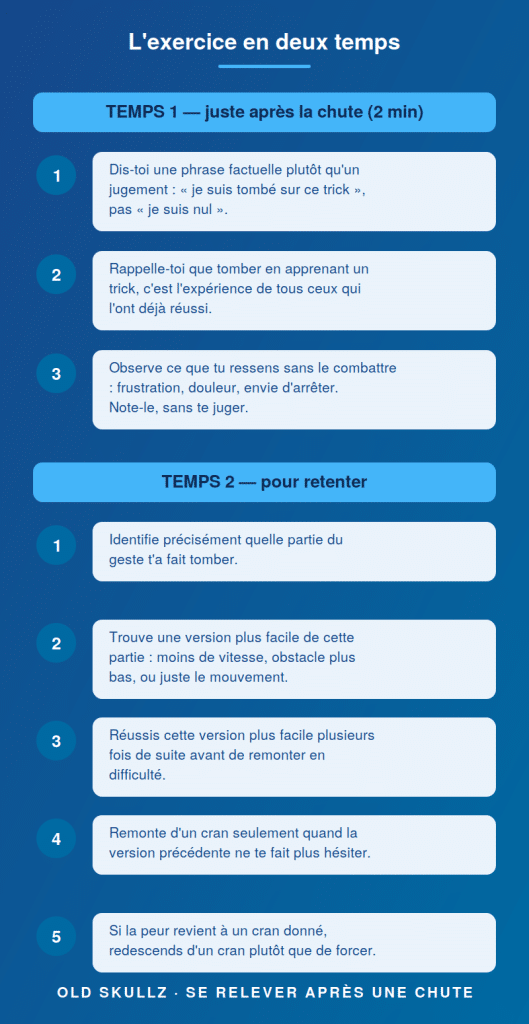
Exercise in two stages
Stage 1 – immediately after the fall, before getting back on the board (2 minutes).
- Use a factual statement instead of a judgement: “I fell trying this trick”, not “I'm terrible at this trick”.
- Remember: falling while learning a new trick is something every skater who has landed it has experienced, not something unusual that only happens to you.
- Notice what you’re feeling without fighting it: frustration, pain, the urge to call it a day. Make a mental note of it without judging yourself for feeling it.
Stage 2 – to try again, in the same session or the next.
- Identify exactly which part of the movement made you fall.
- Find an easier version of this part: less speed, a lower obstacle, or just the movement without the obstacle.
- Pass this version easier several times in a row before going back to trouble.
- Go up a step only when the previous version doesn't make you hesitate.
- If fear returns at a particular step, go back one step rather than forcing it.
Example: After an injury, I started again with the smallest possible step: slowly stepping off my stationary board without any impact, just to feel that my knee could handle that particular movement. Once I had done this pain-free several times in a row, I moved up one step: rolling, then pushing. The next stage, much later, was popping an ollie, with the same question each time: can the joint handle this level? Each stage I completed built the confidence needed to try the next, without ever skipping one.
What you don't need to do
You don’t need to downplay the fall, pretend it didn’t scare you, or wait until you’re “completely recovered” before touching your board again. Both approaches wait for a version of you that doesn’t exist. What works is treating the fall as information to process rather than a verdict, and revisiting the fear in stages rather than all at once.
It’s part of what we work on in the Old Skullz online coaching and in our skateboard lessons : correcting technique, but also rebuilding confidence after a fall that left a mark, whether physical or otherwise.
FAQ
Scientific sources
- Breines, J. G., & Chen, S. (2012). Self-compassion increases self-improvement motivation. Personality and Social Psychology Bulletin, 38(9), 1133-1143.
To go further: read the full self-compassion study: Breines & Chen, 2012 (PDF, English)
- Craske, M. G., Treanor, M., Conway, C. C., Zbozinek, T., & Vervliet, B. (2014). Maximizing exposure therapy: an inhibitory learning approach. Behaviour Research and Therapy, 58, 10-23.
