

In immersion at the Skate Hub
Three lines to find out what to work from your next session.
At Skate Hub, everyone goes back with their own challenge. Here's how to choose yours and try it at the skatepark.
 By Max Cherarak
Skateboard coach and mental performance coach
The essentials in 30 seconds
Choose your challenge before you multiply the tests
Just go with a gesture that you already control, change one thing and define a marker that you can observe. In the end, write down what helped you and what you want to take back.
- Warm-upA familiar movement.
- Today's challengeA precise and observable step.
- ExtrasA little variation, if you keep control.
The vlog
Watch the session at the covered skatepark
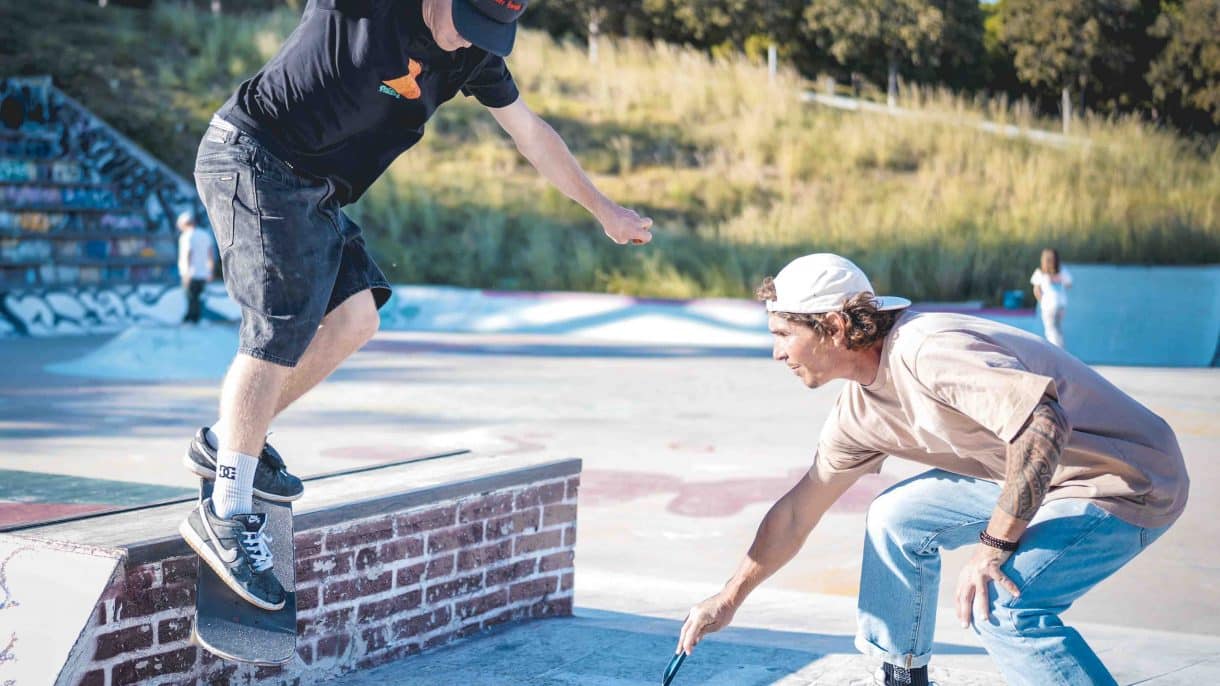
Second day of skating camp in Barcelona. It rains, so you park the van in front of the Skate Hub. You start with a Game of Skate, you discover bowl and modules, then each gets a list of chosen figures together.
The method
How to make a trick list in skateboarding?
In the vlog, a skater is working on a shift-it while another one is trying a 360 flip out of the inclined plane. The figures change, but the question remains the same: what stage has meaning today, for this skater and on this spot?
- Start with a movement you're mastering. Drive, turn and brake on the plate if you begin. If you already master the bases, find your sensations with some ollies while rolling.
- Choose a single challenge. Write down what you want to do and what you will observe. "Rolling in the axis after reception" gives you a more precise mark than "successful my ollie".
- Add an optional bonus. When the movement is controlled, you can vary slightly the speed or trajectory. Keep time to skate freely.
The progress zone
You're in the right trouble if you can try with control, observe a detail and decide what to adjust to the next pass. If your ollie stops, first try rolling slowly on a dish. Pass to an appropriate obstacle when approach and reception are regular.
Exercises by level
Three examples of trick lists to adapt
Beginner
Turn and brake
Departure. Drive at your pace on a flat, clear floor.
Challenge. Make a bend around a marker, then brake in a chosen area.
Bonus. Test the other corner direction.
To be observed · You keep your direction and stop where you planned.
Intermediate
Stabilize the octopus
Departure. Take a few ollies on the plate, driving at a familiar speed.
Challenge. Cross a line on the ground and continue to roll in the axis.
Bonus. Do the same thing with a little more momentum.
To be observed · Both feet remain on the board and the path remains stable.
Intermediate
Regularize a shove-it
Departure. Take that shove-it back on the plate.
Challenge. Put it back on a low inclined plane you know, keep the same approach.
Bonus. Chain with a familiar figure, on an open line.
To be observed · Reception leaves you with enough control to continue your line.
To be tested on your next exit
Your skate session in 15 minutes
Use this format to set a course at the beginning of your session. If you need to drive more before tackling your challenge, extend the heat.
Old Skullz session form
- 5 minutes
Find your backs. Check the ground and reception area. Drives, turns and finds a controlled braking system.
- 3 min
Look at your starting point. Do some tests with the same approach. Keep a little break between the passages to find out what's coming back.
- 5 minutes
Test a single fit. Change a detail, like your point of view or your momentum. If you can, film a passage from the side, out of the path.
- 2 min
Make a point. Note what you observed and choose the first step of your next session.
These times serve as benchmarks. Adapts the effort to the spot, your shape and your level.
Coaching in situation
When should the difficulty be simplified or increased?
Simplify
You lose control every time you try, you get nervous or you can't ride properly. Cut the lantern, come back on the flat or take a familiar move.
Keep the same challenge
The trick sometimes passes and you see what changes between the essays. Take the same version with a single marker until you better understand what helps.
Change one thing
Your approach and reception become regular. Try a slight variation in speed, trajectory or sequence.
The shove-it on the pyramid, in the vlog
The first try ends on the ground. The skater starts over again and replacing. If you compare two tries, first look at one element: did the board come back under you when your feet descend? You'll know better what adjustment to try next.
Sessional review
How do you see your progress even when the trick blocks?
Choose a simple criterion and compare two small series in nearby conditions. One example: out of five ollies, how many receptions let you roll in the axis? Keep the same speed and the same ground marker for comparison.
- My marker · I drive in the axis after reception.
- What I've changed · I have targeted the continuation of my trajectory.
- What I've observed · Example: two in five controlled receptions, then three in five. I check at the next session if this marker still helps.
To go further, find the guide to progress in skateboarding and its 30-minute session.
Frequently Asked Questions
Coach's answers on the trick list
How many tricks do you have to put on a trick list?
Three lines are enough to start with. Choose an easy movement, a challenge and a bonus. If you only have time for one series, work the challenge after being warmed up.
Is it useful when I start skating?
Yes. Your list can only be composed of bases: push, roll in a specific direction, turn or brake. Choose a flat and clear place where you can repeat without disturbing others.
Do we have to change trick list every session?
Keep a part of the list if it makes you further progress. Compares trials in close conditions. When a difficulty becomes regular, changes a single parameter or chooses a new step.
What if I block or I'm afraid?
Return to a familiar movement. You can reduce the speed, return to the flat or simplify the course. Retry only if you regain control. If fatigue or discomfort persists, take a break or end on a controlled exercise.
Can we prepare a trick list without skatepark?
Yes, for the movements adapted to the floor you have. A flat, smooth, clear and authorized space is sufficient for many bases. Keep transfers, rails and other modules for an appropriate spot.
Moving on to practice
Skate camps Old Skullz in Barcelona
Want to discover spots and work on adapted challenges with the group? Find out more about the stay in Spain and the upcoming Old Skullz skate camps.
See dates and registrationsDiscover the skate camp in Barcelona