

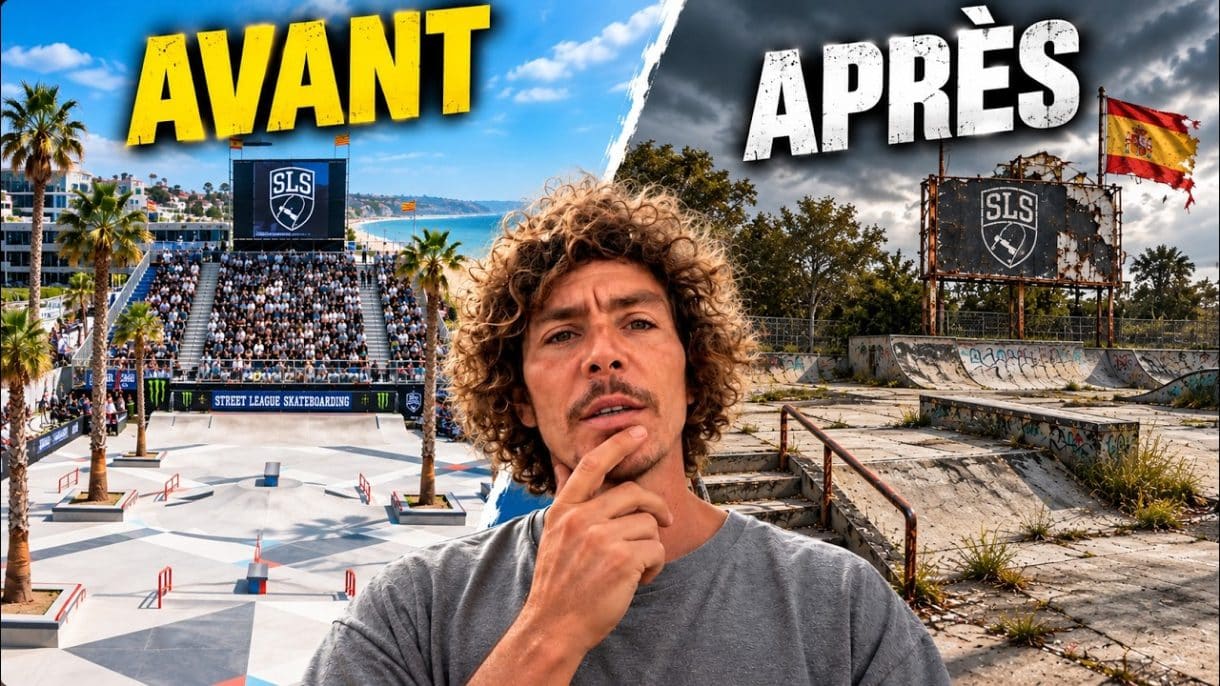
To improve your skateboarding, start with a clear goal and a suitable exercise. Then discover how to organise your sessions, observe your attempts and prepare mentally, even without the perfect skatepark.
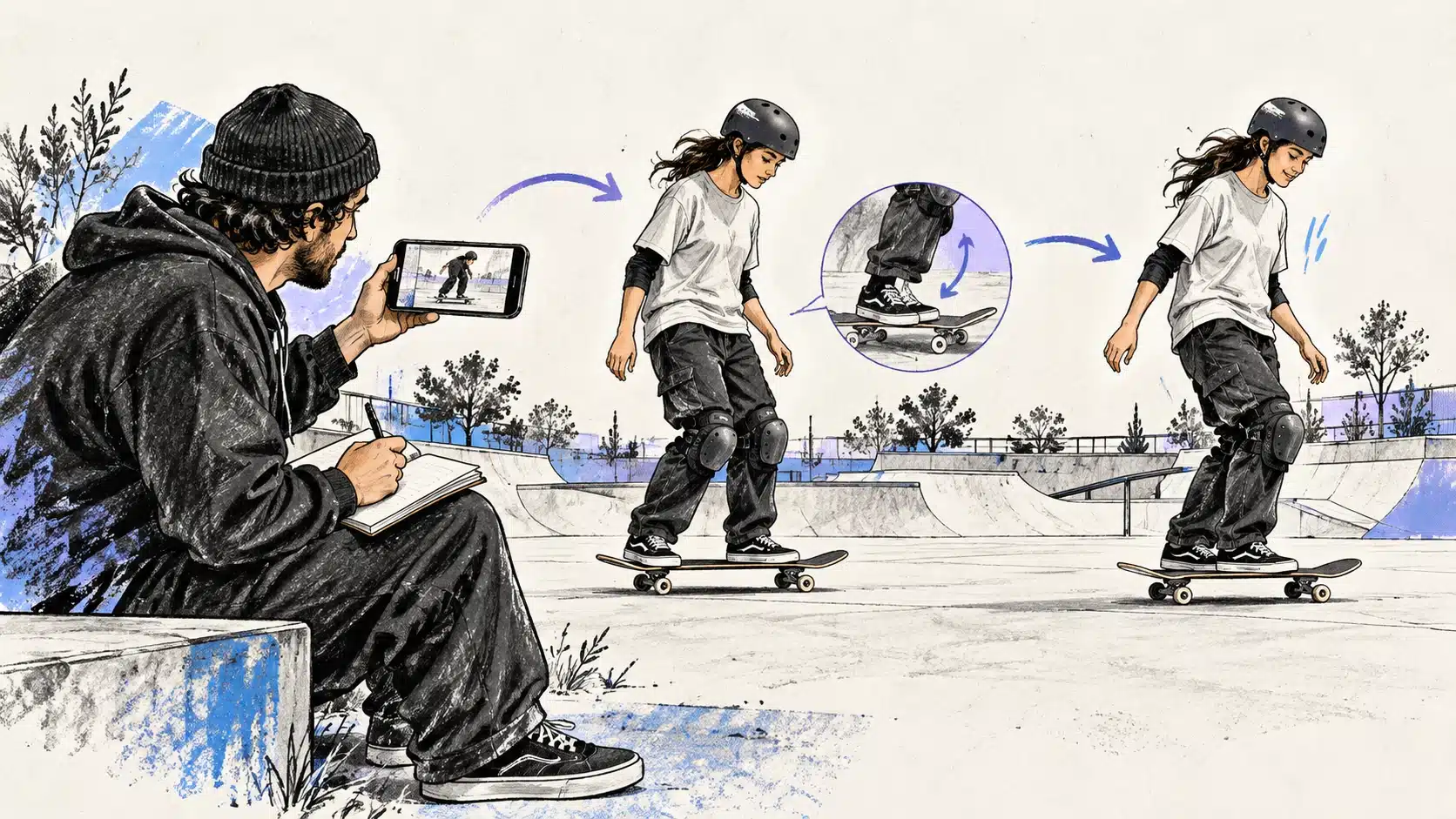
THE ESSENTIALS IN 30 SECONDS
Your next improvement starts with a single objective.
To progress in skateboarding, first choose a skill suited to your level. Then observe a few attempts and adjust one thing at a time. Finally, take stock: what changed, what you learned and what you'll work on next time you go skating.
Test the 30-minute session- A specific objectiveA landing, a line, a braking movement.
- An appropriate level of difficultySteps you can practise safely.
- Observable progressControl and consistency, beyond simply landing the trick.
Imagine a skatepark designed for elite skating, with impressive obstacles and lines planned for the best skaters. Then imagine the same place a few years later: abandoned.
This is the starting point of our video “Skating at the SLS – The abandoned skatepark”. Derrière l’aventure, une question mérite qu’on s’y arrête : Does an excellent skatepark necessarily make you a better skater?
You can have access to amazing spots and still get stuck. Conversely, a few meters of concrete, a board and a clear goal can already teach you a lot. The place matters, and so does the way you learn.
Your needs change depending on whether you're a beginner, returning to skateboarding at 40 or preparing for a competition. To progress in each of these situations, let's first look at organising your training and working on the mental side.
THE ADVENTURE THAT INSPIRED THIS GUIDE
An abandoned skatepark.
A real question of progress.
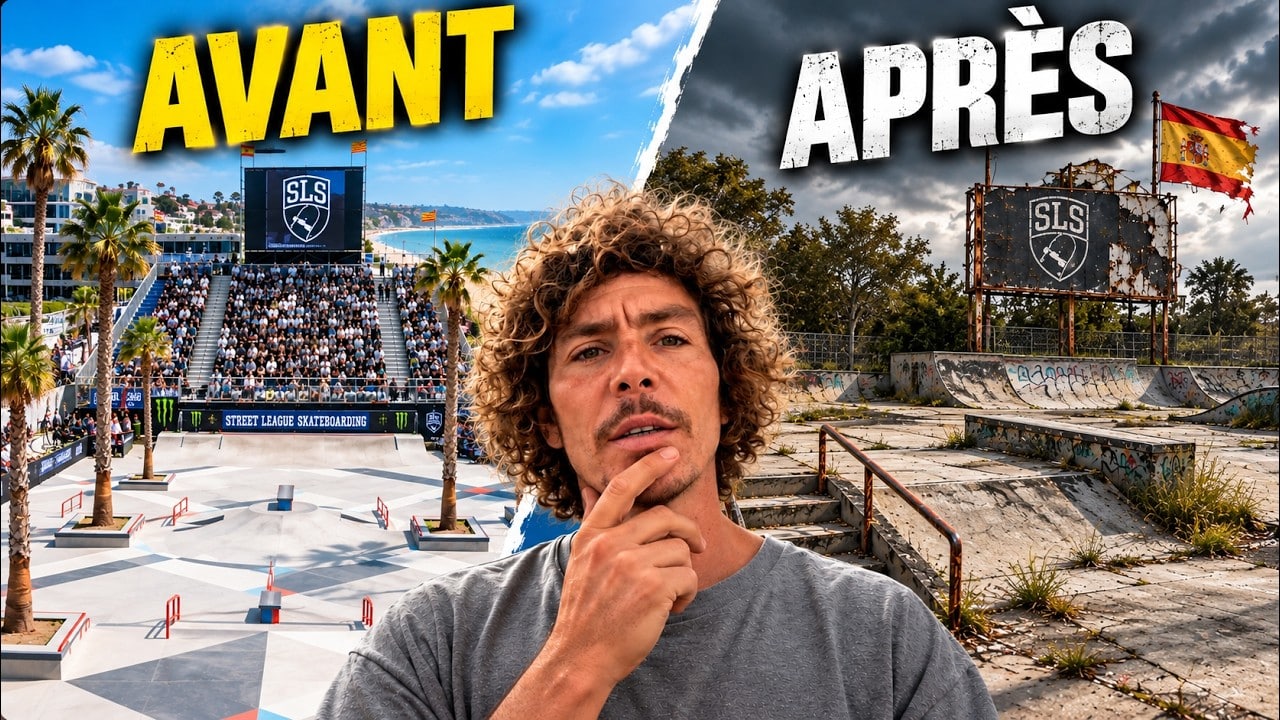 WATCH THE VIDEOWe skate at SLS – The abandoned skatepark
01 / THE PLAYGROUND
Is a small spot enough to advance in skateboarding?
A bigger skatepark, new obstacles, better equipment: it's easy to believe you always need more to progress. Of course, the quality of the surface and safety make a difference. But these resources aren't enough: you also need to learn how to use them.
Let us compare, for example, two ways of approaching a session.
Big skatepark.
Lots of attempts.
You keep switching tricks and getting more tired. In the end, you leave without knowing what was holding you back.
A little spot.
A clear goal.
First choose a skill, then observe where you struggle. That way, you can finish with progress you can identify.
The number of tricks you land doesn't tell the whole story of a session. In the second case, the main gain was a clearer idea of what you needed to learn.
Skating freely and training to reach the next level fulfil different desires. Both have their place, because enjoying skating is part of our sport. A little structure becomes useful, though, when you want to overcome a specific difficulty.
02 / THE METHOD
A simple way to advance in skateboarding
Since founding Old Skullz Skateboard in 2008, I’ve supported skaters from their first contact with a board to the highest level. Many know which trick they want to land, but the steps to get there are unclear. That’s why we begin by clarifying their goal.
Turn your desire into a concrete goal
“I want to get better at skateboarding” gives you a direction. “I want more stable ollie landings” tells you what to work on right now.
- Ride through a small transition without losing all your speed.
- Keep the board under you on your kickflip.
- Land your ollie while keeping your direction.
Find the right level of difficulty
An exercise that's too easy no longer makes you explore solutions. At the other extreme, too much difficulty can lead to constant failure and increase the risk of falling.
For a boardslide, first strengthen your ollie and approach. Then practise on a low, suitable obstacle, so the difficulty increases along with your skills.
Give every attempt a purpose
For example, a kickflip where the board stays behind you gives different information from one where it rotates beneath you but slips away from your front foot. In the second case, part of the movement may have improved.
Repeating is useful, but understanding what you repeat also gives you direction to progress in skateboarding.


03 / TRY IT ON YOUR NEXT OUTING
Your 30-minute session
to advance in skateboarding
Here’s a simple framework to adapt to your level, how you’re feeling and the time you have. The 30 minutes are a practical reference, not a scientifically ideal duration.
- 5 minPrepare
Check the spot first, then warm up gradually. Get your feel back with some easy riding.
- 7 minObserve
Then practise the chosen movement and identify your main difficulty. A few filmed attempts can help.
- 12 minAdjust
Then do short sets, with breaks. Focus on one correction at a time so you can understand its effect.
- 4 minConsolidate
Then return to a version you've mastered. If you're ready, try a small variation too.
- 2 minReview your session
Finally, note what has improved and choose your next little goal.
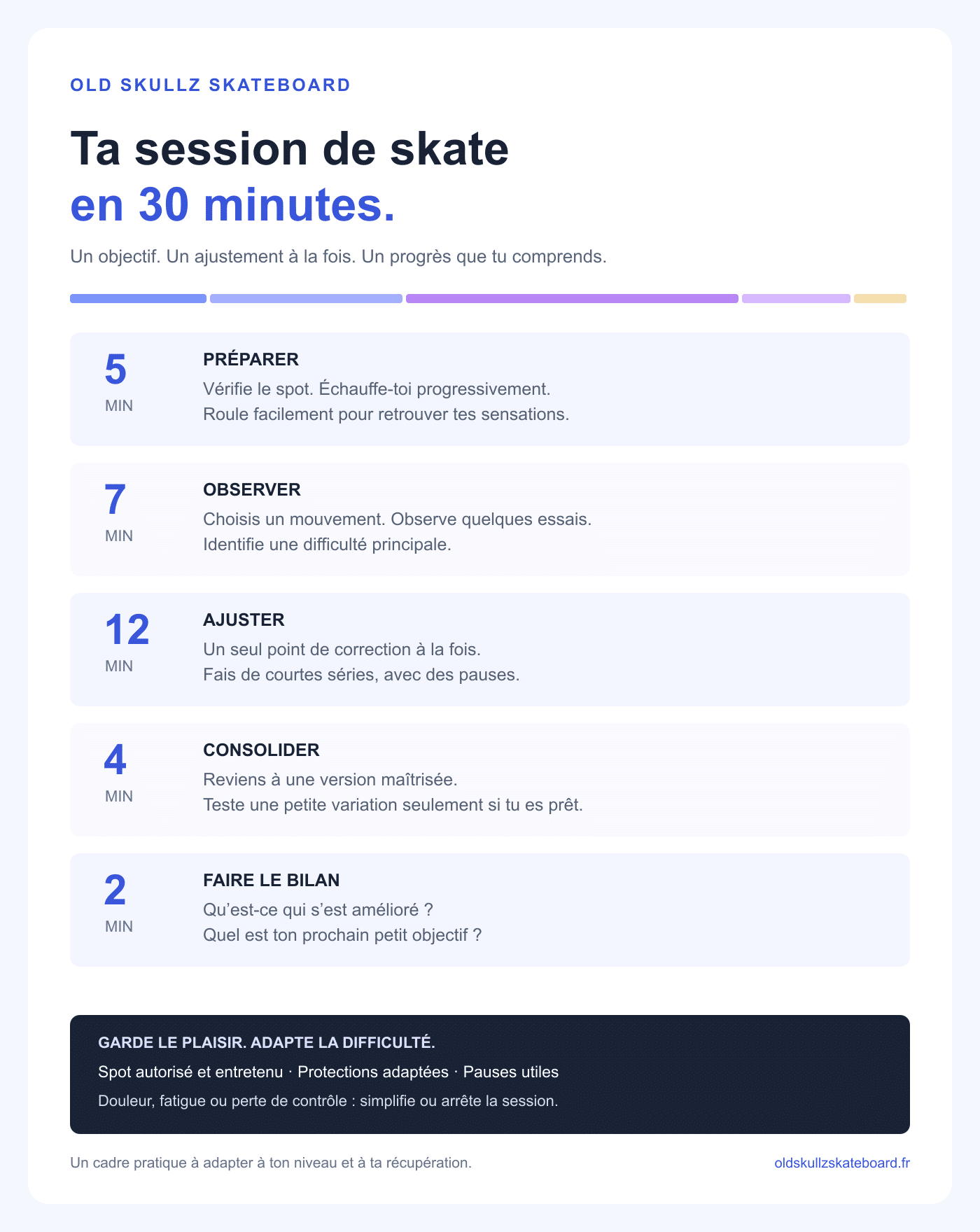
Save this image on your phone so you can refer back to the steps. Adjust the breaks to suit your needs, though.
Just one cue: roll away straight after landing.
Start with a few easy runs. Then film yourself from the side or at a three-quarter angle and observe your balance and direction. Choose one priority to work on, and take time to see what changes between attempts.
In the end, ask yourself: "Do I understand better what will help me on the next ollie?"
04 / TECHNIQUE & MENTAL PREPARATION
What research teaches us about progressing in skateboarding
To progress in skateboarding, repetition is not enough to explain everything. Your goals, your attention and the preparation of the movement also matter. Here are three points to reflect on your training.
Focus on what you can work on
A review of 27 studies, published online in 2022, reports beneficial effects of process goals on performance and self-efficacy. [1]
A concrete intention thus facilitates observation and adjustment, but it does not guarantee the trick.
Give yourself one simple cue when it’s time to act
A 2024 review of 12 studies reports encouraging results for focusing attention on the effect of the movement. Findings on a holistic focus remain less certain, with few studies available. [2]
This cue may therefore be easier to use than thinking about your knees, hips and shoulders all at once. The right cue depends on your level, the trick and the situation, though.
Prepare a movement you know
Imagery means deliberately picturing an action, including its sensations and reference points. A 2025 meta-analysis of 86 studies reports an overall positive effect on sports performance. [3]
Before a familiar movement, revisit your approach, your line and a controlled landing, for example. Mental imagery complements physical practice; it doesn't replace it.
These studies cover different sports, however. The examples in this article are teaching applications for skateboarding, not protocols that have all been experimentally validated with skaters.
05 / CHOOSE YOUR STARTING POINT
Three exercises to advance in skateboarding, depending on your level
Choose the exercise that matches your current skills. You can then stick with a simple version for as long as you need.
The control challenge
To start, choose a short route on a smooth, clear surface where skating is allowed.
- Push first, then reposition your feet.
- Then move forward at a speed that you control.
- Finally, come to a controlled stop.
- Once you've mastered the route, add a gradual change of direction.
Your progress reference pointYou can control your movement and stop.
The challenge of consistency
This time, choose a trick you land sometimes, but not always.
- First, count how many controlled landings you make in ten attempts.
- Then find the most common difficulty.
- Then choose a single adjustment.
- Finally, once you've recovered enough, compare a new set under the same conditions.
Your progress reference pointYou understand what makes the trick more reliable.
The challenge of adaptation
To go further, start with a trick you've already mastered, in a safe environment.
- Start by slightly changing your speed, line or sequence.
- However, change only one variable at a time.
- Then observe how controlled your landing is.
- Finally, go back to an easier version if your control deteriorates.
Your progress reference pointYou retain your skill in a variety of situations.
Variation must still suit your level and how you’re feeling. It’s there to help you learn, without increasing risk for its own sake.
06 / MINDSET IN SUPPORT OF ACTION
Progressing in skateboarding after a failed try
You may not have landed your boardslide, but your approach has improved. Likewise, hesitating on your drop-in can help you understand what's holding you back. You can then use that information to improve your skating.
Assessing your session differently doesn't mean giving up on performance. On the contrary, it helps you recognise the steps that lay the groundwork for success.
THE ONE-MINUTE REVIEW
Three questions to move forward with a direction
- What did I achieve today?A trick, a well-managed effort or a smart decision.
- What did I learn?A precise answer that goes beyond “it was good” or “it was rubbish”.
- What's my next little goal?A feasible action, consistent with my level.
07 / YOUR EXPERIENCE OVER TWO WEEKS
The 14-day challenge to progress in skateboarding
First choose a skill: a turn, an ollie, a manual, a drop-in or a more advanced trick. Then watch it on four sessions spaced out according to your availability and recovery. Keep the same reference points so you can compare.
- SESSION 1Observe
First, film a few attempts to establish your starting point.
- SESSION 2Correct
Then choose a technical point and an appropriate exercise.
- SESSION 3Consolidate
Then see whether the movement becomes more controlled or more consistent.
- SESSION 4Evaluate
Finally, film in comparable conditions so you can see what changes.
At the end, then, take stock: has my movement changed? What difficulties do I understand better? What stage can I work next?
Spectacular progress in two weeks isn't guaranteed, though. You may need to adapt the exercise, allow more recovery time or get an outside perspective. You'll then have information to guide your next steps.
08 / THE PLEASURE OF SKATING FOR YEARS TO COME
What kind of spot can help you progress in skateboarding?
An abandoned skatepark can be fascinating to explore. However, cracks, debris, poor grip, unstable structures or prohibited access can change the conditions. To progress in skateboarding, choose a suitable place to learn, especially if you're a beginner.
Four useful checks
- An authorized and maintained locationCheck the surface, obstacles and routes people use.
- Suitable protective gearIncluding a helmet, and equipment in good condition.
- A manageable challengeAdapt the exercise to your skills and how you feel that day.
- Fatigue you pay attention toPain, loss of focus or loss of control: reduce the difficulty or stop the session.
The goal thus goes beyond the next trick: it is also about being able to continue skating in several years.
09 / YOUR QUESTIONS
Progress in skateboarding:
the coach's answers
Can you improve without a large skatepark?
Yes, a suitable, safe space is enough to work on balance, board control and steering. Tricks that require specific obstacles, however, need an appropriate setting.
How many times a week do we have to skate?
There's no universal training frequency: it depends on your level, recovery, goals and how demanding your sessions are. Aim for regular practice you can maintain, rather than piling up overly tiring sessions.
How can we progress when we're afraid of falling?
First identify what is causing the apprehension: speed, height, lack of control, a previous fall or concern about others’ opinions. Then return to easier steps, without forcing yourself onto an obstacle beyond your current abilities. A coach can also help you build this progression.
Find support that suits you ↗Is it too late to improve at 30, 40 or 50?
No, you can still learn as an adult. However, adapt your practice to your experience, fitness, recovery and any history of injuries. That way, you build a training routine that suits your body and your life.
10 / WHAT YOU TAKE WITH YOU
The skatepark can disappear.
What you learn can stay.
You can build an exceptional spot, have memorable sessions there, and then see the place change or disappear. Yet the skills, friendships and experiences can stay with you.
Since 2008, that's what I've aimed to pass on through Old Skullz Skateboard. Learning an ollie, kickflip or boardslide also teaches you to observe, persevere, make decisions and manage your emotions.
Every session doesn't have to become a life lesson. Sometimes you just want to roll, laugh with your friends and enjoy. But when you want to progress, ask yourself this question:
"What would I like
A starting point for your next session.
learn today?"
The skatepark is still your playground. Learning how to progress in skating becomes a skill you can take anywhere. See you on your board soon!
MOVE FROM READING TO PRACTICE
Your next milestone,
We're building it together.
To put things into practice, choose the format that suits your plans: lessons to build the foundations, camps for varied experiences or coaching to work on your goals.

Skateboard lessons
Children, teenagers or adults: solid foundations, then steps tailored to you.
Explore the lessons ↗
Workshops & Skate Camps
New spots and shared experiences, so you can learn from the group too.
See the camps ↗Remote coaching
A technical assessment, followed by personalised support for your goals.
Discover coaching ↗
THE AUTHOR
Your coach to advance in skateboarding: Max Cherarak
I'm the founder of Old Skullz Skateboard, a skateboarding coach and a mental performance coach. Since 2008, I've worked with skaters from beginners to elite athletes. My work brings together technique, enjoyment and lasting progress.
Discover my background and qualifications ↗Sources for further reading
- Williamson et al. — The effects of goal setting in sport on performance and psychology: a systematic review and meta-analysis.Published online in 2022 · Process goals, 27 studies.
- Favre-Bulle et al. (2024) — The effect of attentional focus on learning sports movements in healthy adults.PeerJ · Attention and motor learning, 12 studies.
- Liu et al. (2025) — The effects of imagery on sports performance: a meta-analysis and systematic review.Behavioral Sciences · Imagery and sports performance, 86 studies.
References are presented with descriptive titles in French; the links lead to the original publications. These studies cover different sports, and the exercises presented here are coaching suggestions applied to skateboarding. Photos: Old Skullz Skateboard. Teaching illustration created for this article.
Return to top ↑