
The Journal · Your first session at the skatepark
New to the skatepark: how to get started without struggling
Can you already push, turn and stop on flat ground? Here are the pointers to understand the skatepark, find your place and prepare for your first session.
Start the guide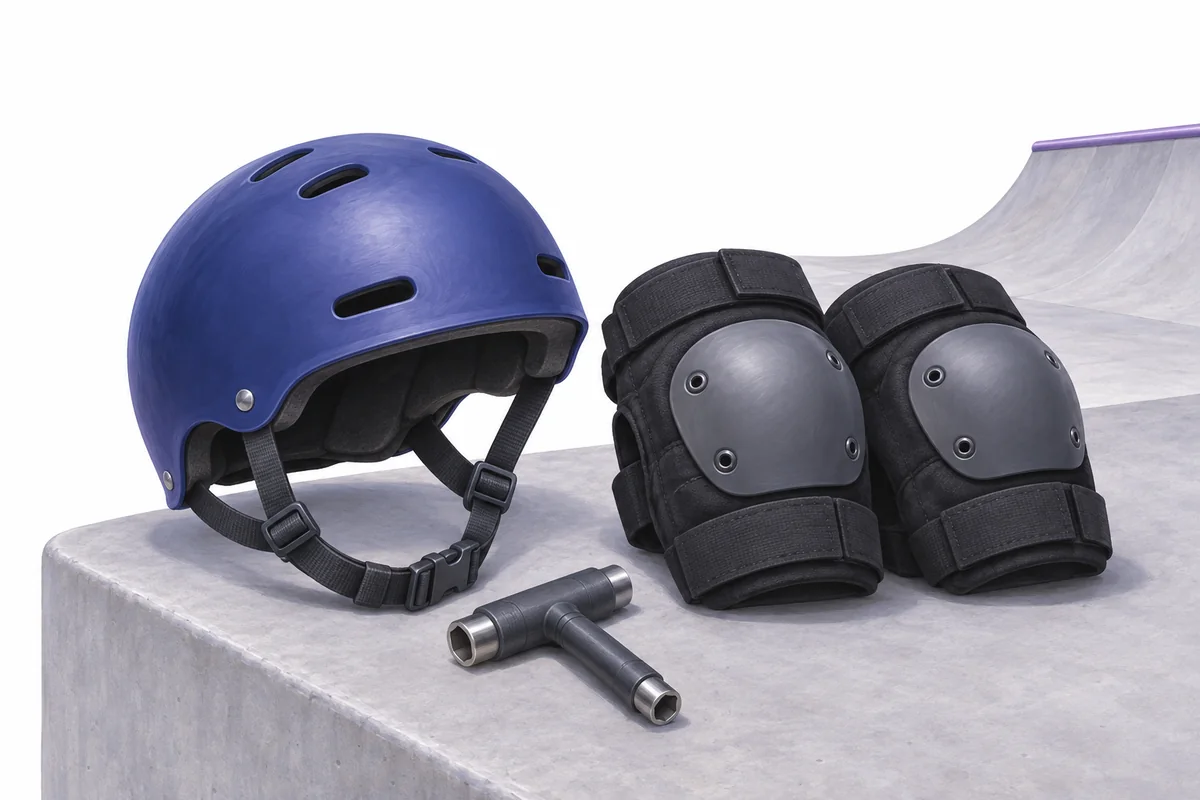
Suitable equipment and protective gear
Areas, trajectories and rules
The basics before skatepark obstacles
Old Skullz
Rules, safety and progression: the guide you should have been given
Equipment, skatepark etiquette, the right obstacles in the right order—everything you need to know before your first session.
You know how to ride. You can make a few turns, brake reasonably well and no longer feel completely lost on a board.
But the skatepark is another matter. That world of ramps, obstacles and riders who seem to know exactly what to do and where to go can be intimidating. And that's normal.
What I see most often is people waiting weeks, sometimes months, before stepping through a skatepark's gate.
Not because they can’t skate, but because nobody has explained the rules: how it works, where to stand, how to read a spot and how to stay out of other people’s way without hiding in a corner.
This guide is the briefing you should have had before your first session. We’ll cover everything you need to know: safety, unwritten skatepark rules, the order in which to get comfortable with obstacles, and common mistakes that turn a first session into a bad memory. Whether you’re 12 or 35, going alone or with your child, by the end you’ll be ready.
If you're a complete beginner, I recommend first reading our complete guide to learn skateboarding.

1 - before entering
Equipment: not glamorous, but non-negotiable
The first thing I tell every beginner I coach: protective gear isn’t optional. It isn’t “for people who are bad at skating” or “for children.”
It's for everyone and especially those who start.
Minimum equipment before entering a skatepark
? Certified helmet (CE EN 1078) - protects against head impacts, essential on obstacles
? Knee pads – knees take the first impact in 80% of beginner falls
? Wrist guards - the natural reflex is to put your hands out, and your wrists take the full impact
? Shoes with flat, stiff soles - running shoes with thick soles are dangerous
An important clarification about helmets
Not all helmets offer the same protection. A standard bicycle helmet protects well against frontal impacts, but not the side impacts that can occur in skateboarding.
Ideally, choose a certified skate or multisport helmet (dual EN 1078 + ASTM F1492 certification).
Remember. : a helmet which has taken a significant impact must be replaced, even if it is not visibly damaged.
For parents
If your child refuses a helmet because “it's not cool”, here's the argument that works best: all pros wear helmets when learning.
Nyjah Huston, Tony Hawk, Joseph Garbaccio, Max Berguin, all the riders on the French national team. They all wear helmets when working on new tricks. Protection is what lets you try more, not less.
2 - read a skatepark
Understanding a skatepark: zones, traffic flow and reading obstacles
A skatepark isn’t a random playground. It has a logic, unwritten zones and patterns of traffic. Understanding that logic is the first skill to develop, before you even ride onto an obstacle.

Read the flow: who is going, In what order?
In a busy skatepark, riders take turns on the obstacles. There's an unspoken flow, like traffic. Watching that flow before joining in is the first thing to do when you arrive at a new spot.
Coach's advice
Basic rule: when you arrive at an unfamiliar skatepark, spend 5 to 10 minutes just observing. Who’s using what? How do skaters take turns on obstacles? Where is the least crowded area for beginners? Those 10 minutes of observation are worth more than an hour of a poorly managed session.
3 - the rules
Find a place to wait and leave your belongings outside the riding lines.
Look for available flat ground to practice movements you already control.
Watch the lines all the way to the end and the exchanges between riders before setting off.
The unwritten rules of the skatepark: the code nobody posts but everybody knows
| 1 |
Rotation on obstacles When several riders want to use the same obstacle, take turns in order of arrival. One rider has a go, then goes to the back of the queue, and the next rider takes a turn. Don't make 10 attempts in a row while others are waiting. |
| 2 |
Never cross an obstacle while a rider is on a run This is the number one safety rule. When a rider is approaching or riding an obstacle, their line has priority. Don't cross it, don't enter their space: wait until they've finished. Always. An accident can happen very quickly. |
| 3 |
Announce your line on shared obstacles Before setting off on a busy ramp or quarter pipe, a simple “I'm going” or “go” lets others know. It's a habit you pick up quickly that helps prevent collisions. |
| 4 |
Do not stand still in the middle of a riding line Flatground and transition areas are routes people skate through. Stopping there to chat or check your phone blocks the flow and creates dangerous situations. If you want a break, move to the edges. |
| 5 |
Retrieve your board immediately if it rolls away A loose board rolling through a skatepark is a hazard. If your board rolls away after a fall, retrieve it or warn the other riders. Don’t let it cross an active area. |
| 6 |
Mutual respect applies at all levels A beginner belongs at the skatepark just as much as a pro. The skateboard community is generally welcoming to people who respect the rules and stay humble. If you don’t know how to do something, say so. If you need advice, ask. Most skaters are happy to share. |
4 - progression by modules
Which obstacles should you tackle first?
A logical progression to avoid skipping steps
The most common mistake I see among beginners at the skatepark: wanting to try everything at the same time. It's the recipe for getting hurt, getting discouraged, and leaving with a bad memory.
Progressing in a skatepark follows a logic. Each obstacle prepares you for the next. Here's the order I teach at Old Skullz, designed to help you progress quickly while staying safe.
| Flat ground - Flat area [ Beginner ] |
|
|
Flatground is where it all starts. No slope, no height, no speed forced on you. It's the ideal environment for learning the basics: balance while moving, pop, slides and your first tricks. Don't neglect it by rushing onto obstacles too soon. |
|
| Prerequisites |
Know how to push and stop, balance while rolling, and turn right and left. |
| First objectives |
Master the manual (rolling on the rear wheels), practise stationary ollies and then rolling ollies, and learn your first 180° turns. |
| Frequent error |
Wanting to “move on to the ramp” too soon. Some beginners find flatground boring because it seems basic. In reality, everything you learn there is the foundation for the rest. A clean flatground ollie is the gateway to all the obstacles that follow. |
| The quarter ramp - Quarter pipe [ Beginner + ] |
|
|
A quarter pipe is your first encounter with a sloping surface. This is where speed comes into play, your balance adjusts and the sensations really change. Approach it well and it's a revelation. Approach it badly and it can cause serious falls. |
|
| Prerequisites |
Clean, consistent ollies on flat ground, confidence riding at a moderate speed and good overall balance. |
| First objectives |
First, push gently up the ramp and roll back down without doing a trick. Then learn the kickturn (turning at the top of the ramp). Then work progressively on drop-ins, starting from the lower section. |
| Frequent error |
Trying to drop in from the top before getting comfortable with the ramp from the bottom. Dropping in from the top of a quarter pipe is technically demanding and takes mental commitment. It requires preparation; you don’t improvise it on your first day. |
The golden rule of progressing obstacle by obstacle
Move to the next module when you can do the previous one successfully in 8 out of 10 attempts, not when you've managed it once. Consistency is the criterion, not a one-off success. That's the difference between making real progress and building on shaky foundations.
5 - the mistakes to avoid
The 7 classic beginner mistakes at the skatepark (and how to avoid them)
Error 1 - Arrive without observing
Rolling into a skatepark without taking time to read the space. We've seen why this is a problem. Make those 10 minutes of observation a habit at every new spot. It's an investment, not a waste of time.
Error 2 - Choosing an obstacle too difficult too soon
Drawn to the highest ramp or the most imposing bowl, some beginners skip steps. The result: a serious fall, lasting fear and a setback. Progressing in stages isn't a restriction; it's what makes progress sustainable and the experience positive.
Mistake 3 - Skating with unsuitable equipment
A board that's too big or too small, poorly adjusted trucks, wheels that are too hard for the surface: your equipment directly affects safety and progress. If you're a beginner, have someone knowledgeable check your setup. At Old Skullz, this is an integral part of our first lessons.
Mistake 4 - Ignoring fatigue
The worst falls often happen late in a session, when concentration drops and reflexes slow. Learn to recognise your signs of fatigue and stop before they become dangerous. A short, controlled session is better than a long one that ends in hospital.
Error 5 - Taking too many risks to "impress"
The ego is a bad coach. Wanting to show what you can do or what you can't yet do in front of other riders is one of the causes of unnecessary injuries. At the skatepark, nobody asks you to perform. You're here to progress. That's all.
Mistake 6 - Not knowing how to fall
We talked about it in our guide on fear of falling : knowing how to fall is something you learn. Riders who have never practised it tend to lock their arms or fall stiffly, which maximises injuries. Learning to roll on the ground, absorb the impact with your forearms and let yourself slide is a fundamental skill I teach from the very first session.
Mistake 7 - Comparing your progress with other people’s
The skatepark makes differences in ability visible. Watching advanced riders can quickly discourage you if you compare yourself to them. Remember: these riders have years of practice behind them. The only useful comparison is with yourself last week. Focus on your own progress.
6 - A word from the coach
What I tell all my riders before their first skatepark session
After 18 years of accompanying beginners of all ages in their first contact with the skatepark, I have a strong conviction: what makes the difference between a successful first session and a traumatic first session is neither the talent nor the technical level. It's preparation.
Riders who prepare for their first session, know the rules, have the right equipment and know which obstacles to try and in what order arrive with a different kind of confidence. They fit in better, progress faster and, above all, come back. Those who arrive unprepared in an environment that overwhelms them often leave with a bad impression that can last for months.
"A skatepark doesn't scare those who understand it. And understanding takes preparation. You don't need to be good to deserve your place in a skatepark. You just need to respect the rules and approach it with humility."
And if you really want to give yourself the best chance with that first experience, or help your child approach it confidently, one option can make a real difference: working with a coach from the start.
Skate
Start with Old skullz: beginner classes and Skate Camps
At Old Skullz, we have been helping beginners of all ages for over 18 years.
Our beginner courses and Skate Camps are designed precisely to turn this first experience into something positive, structured and memorable.

Skateboard lessons

Skateboard lessons in Avignon and nearby
To learn, improve and push yourself. At any age.

Online coaching
Online coaching
You want to progress wherever you are, at your own pace?
We support you with a clear plan and an outside perspective.

Courses and Skate Camps

An immersive week to learn as much about yourself as about your skating.
See the dates
Old skullz
Join us to follow our adventures!

oldskullzskateboard
?? A unique experience
? Courses • Skate Camps • Mental preparation
? Professional coaching for all levels
?? Here we help you improve
Understanding the ollie? Learn with @maxx_hat ??
There's something fascinating about the best skaters.
What if the biggest obstacle to your progress in sk
Chloé is a comic book artist and illustrator. ? E
Skate emotions ? @oldskullzskatecamp Summer memor
Understand the Pop Shove It ? Learn with @maxx_
Load more
Follow on Instagram

The skatepark is waiting for you.
Now you have everything you need to get there with confidence.
And if you want to be accompanied to go even further, Old Skullz is here.
See you soon,
Team Old Skullz
Old Skullz videos to get ready for your session
Two resources from our channel to help you think about protective gear and discover the support we offer in lessons. They complement your reading; they do not replace observing the spot.
 Do you have to wear PROTECTIVE GEAR when skateboarding?Play video · Old Skullz Skateboard
 THE SKATEBOARD LESSON THAT CHANGES HOW YOU LEARNPlay video · Old Skullz Skateboard
Your checklist before you roll
Before departure
Check access, opening hours, any booking requirements and rules on the city’s or operator’s website. Information in a guide can change.
When you arrive
Check the ground’s condition and moisture, debris, riding lines and how busy it is. Choose an area suited to what you can already control.
For your session
Bring your equipment, protective gear and water, and plan somewhere to take a break away from the lines. If the spot is unsuitable, change areas or come at a different time.
Can you name the zones, explain the rules and identify where to wait without getting in the way? Find these pointers in the final stage of the beginner path. Pour choisir un lieu, consulte our guide to skateparks in France.