Ankles, knees, wrists, back: the comprehensive prevention guide against skateboard injuries
The vast majority of skateboarding injuries are preventable. I'll explain which ones, why and how.
‘I had my first major injuries at a time when nobody talked about prevention in skateboarding. We fell, got injured and returned too soon. We didn't know how to warm up or recover. I paid a heavy price: months off, setbacks and a moment when I really thought it was over for me. What I learned during that time is that injury isn't inevitable. It's almost always the result of a build-up of avoidable mistakes. Today, that experience is at the heart of the way I teach at Old Skullz. Because skating for years takes preparation.’ – Word of Max, founder of Old Skullz


Injury in skateboarding, it's the subject nobody wants to talk about until it happens.
And it happens to everyone: beginners discovering new sensations and falling before they’re ready, intermediate skaters pushing their limits too quickly, adults returning after a long break with a body that doesn’t respond quite as it used to, or parents seeing their child come home limping.
The good news is that the vast majority of skate injuries are preventable. Pas toutes, les accidents existent.
But repeated ankle sprains, persistent knee tendinitis and back pain that returns every session are signals.
Signs that something in your skating needs correcting.
Why skateboarding challenges your body differently other sports
Skateboarding involves repeated impacts on hard surfaces. Chaque réception, chaque pop, chaque contact avec le sol génère une onde de choc qui remonte dans les chevilles, les genoux, les hanches et la colonne.
Unlike running or cycling, where movement is continuous and gradual, skateboarding alternates bursts of explosive effort with hard impacts, often poorly absorbed, especially when you’re starting out.
What also characterizes skateboarding is its asymmetry. Tu as un pied sur l’avant et l’autre sur l’arrière de la planche. Tu pousses d’un côté. Tu tords ta cheville toujours dans les mêmes directions.
This asymmetry, repeated thousands of times, creates muscle imbalances that are behind most of the chronic injuries.
Finally, skateboarding is a a sport you learn independently, without medical supervision or a physical preparation programme. You get on the board, try, fall and start again.
That’s what makes it an accessible, free-spirited sport but which also leaves prevention aside for many practitioners. This is precisely what we are trying to correct with our skateboard lessons and our Skate Camps.
What it changes for your practice
Understanding the demands skateboarding places on your body helps you understand where to focus your injury prevention.
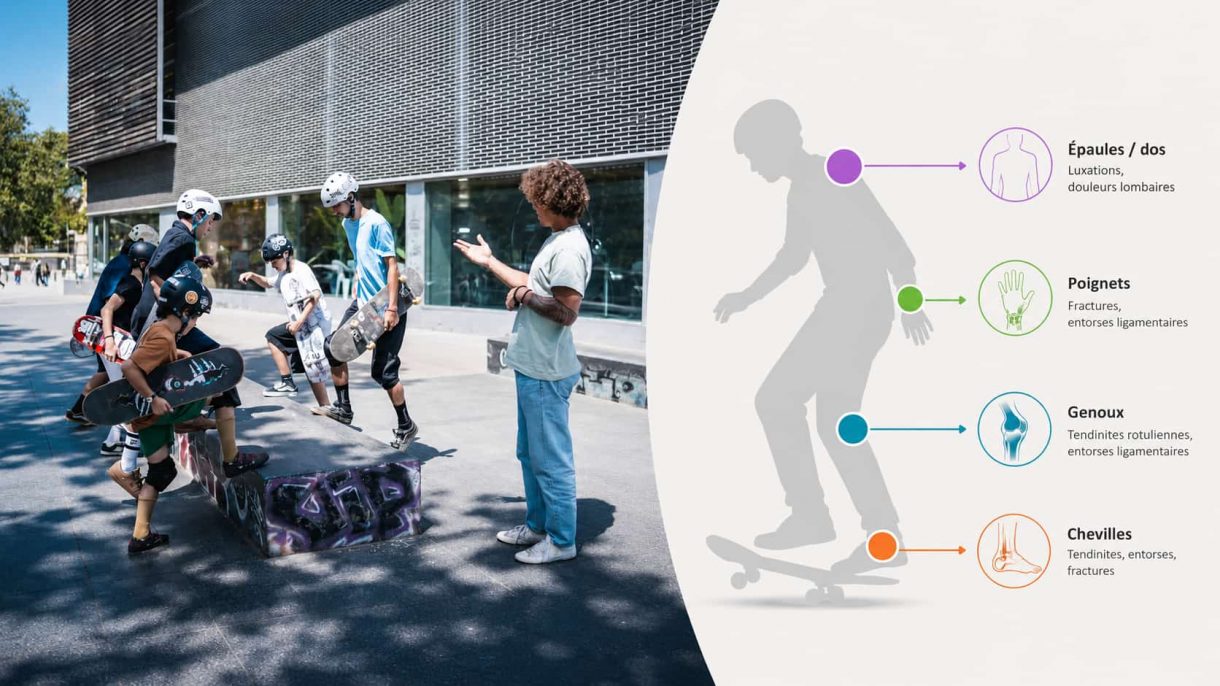
The ankles absorb impacts and twists. The knees absorb compression and rotations. The wrists undergo falls. The shoulders and back compensate for postural imbalances.
Each area has its specific risks and solutions.
Ankles, knees, wrists, shoulders: the 4 areas at risk in skateboarding
Here are the four main areas of vulnerability in skateboarding.
For each one: what happens, the signs you should never ignore, practical prevention steps and the most common mistake.
| Zone: ankles | |
| Frequent injuries | In my experience as a coach, a lateral ankle sprain (outer ligament) is the most common skateboarding injury across all levels. It happens during an off-center landing, when putting weight on the board’s edge, or on contact with the ground in a fall. Achilles tendinitis is the most common chronic injury; it develops gradually in riders who do not stretch and repeatedly have intense sessions. |
| Warning signs | Sharp pain around the outer ankle bone after a fall or landing. Swelling or bruising, even mild, within 24 hours. A dull, persistent ache in the heel or tendon at the end of a session: an early sign of developing tendinitis. Never return to skateboarding with a sprain that is “not too bad” without medical advice: an inadequately treated sprain is the main cause of chronic ankle instability. |
| Prevention | Strengthen your ankles regularly with single-leg balance exercises, calf raises and resistance-band exercises. Wear skate shoes with good lateral support; shoes that are too soft increase the risk of sprains. Warm up your ankles with rotations before each session (30 seconds per foot). Learn to land with your weight centered over both feet; uneven landings are the main cause of sprains. |
| Frequent error | Returning too soon after a sprain. ‘It's just a small sprain’ is one of skateboarding's most dangerous phrases. A sprain that hasn't healed can easily be sprained again and develop into chronic instability. Rule: no skateboarding until standing on one foot is painless and stable. |
| Area: knees | |
| Frequent injuries | A skater’s knee faces two types of stress: vertical compression on each landing and lateral rotation during tricks involving body rotation. The most common injuries are patellar tendinitis (pain below the kneecap, often in riders who do a lot of jumps), patellofemoral pain syndrome (diffuse pain around the kneecap, often in riders who are still growing), and collateral ligament sprains from falls. |
| Warning signs | Pain below the kneecap that increases when walking downstairs or after an intense session: an early sign of patellar tendinitis. A pop or crack in the knee accompanied by pain. Knee swelling in the hours after a session. Pain that worsens over several weeks without recovery time: never let chronic knee pain develop without seeking medical advice. |
| Prevention | Strengthen the quadriceps and hamstrings: they stabilise the knee and absorb impacts for you. Squats, lunges and eccentric strength exercises. Learn to bend your knees on landing: landing with straight knees transmits the entire impact to the joint. Alternate intense sessions with lighter ones. Avoid skating on very hard surfaces (concrete) without alternating with softer surfaces (wooden skateparks). |
| Frequent error | Ignoring knee pain and assuming it will go away on its own. Untreated patellar tendinitis can develop into a disabling chronic condition. In young, growing riders, Osgood-Schlatter disease (pain in the shin just below the knee) can occur and requires medical follow-up, not just rest. |
| Area: wrists | |
| Frequent injuries | The wrist is the area most often affected by skateboarding falls. The natural reflex is to put your hands out to protect yourself, concentrating the fall's energy on your wrists. Scaphoid fractures (which can be difficult to diagnose on a standard X-ray), distal radius fractures, ligament sprains and tendinitis are the most common injuries. Wrist guards drastically reduce these risks. |
| Warning signs | Pain in the anatomical snuffbox (the hollow between the thumb and wrist) after a fall: this may indicate a scaphoid fracture, often not visible on a standard X-ray. Always seek medical advice, even without a visible deformity. Persistent wrist pain several days after a fall, even a minor one. Loss of grip strength or mobility: a sign of a ligament injury. |
| Prevention | Wear wrist guards: this is the number one preventive measure for this area. In skateboarding, the protection they offer is well worth the inconvenience. Learn to fall by rolling onto your forearms rather than landing on outstretched hands. Strengthen your forearms and wrist-stabilizing muscles with resistance-band exercises and rotations using a light dumbbell. Stretch your wrist flexors and extensors after every session. |
| Frequent error | Skipping medical advice after a fall “because it still moves”. A scaphoid fracture is a major pitfall in skateboarding: it often goes unnoticed on the first X-rays, may cause little pain in the first few days, and can lead to bone necrosis if untreated. Any persistent wrist pain after a fall warrants a medical consultation. |
| Zone: shoulders and back | |
| Frequent injuries | Less often discussed, but just as important for regular skaters, are shoulder pain (dislocations and rotator cuff tendinitis after sideways falls) and chronic lower-back pain linked to skateboarding's asymmetrical stance. Always pushing on the same side, leaning forwards in your skating stance and absorbing impacts with an unbalanced body all create muscle tension and postural compensations that build up. |
| Warning signs | Shoulder pain that limits arm movement after a fall: seek medical assessment to check for a dislocation or fracture. Persistent lower-back pain after sessions, which improves with rest but returns every time you skate. Back stiffness at the start of a session that doesn't go away after warming up. |
| Prevention | Include thoracic and lumbar mobility work in your warm-up. Strengthen your back and core muscles: they stabilize your posture and protect your spine during impacts. Occasionally alternate your skateboarding stance (goofy/regular) to offset imbalances. Regularly stretch the posterior chains (hamstrings, lower back, pectorals). |
| Frequent error | Attributing all back pain to “fatigue” without trying to correct your posture or strengthen your core. A skater's chronic lower back pain is almost always linked to a muscle imbalance that can be corrected, but requires regular work off the board. |
What equipment of protective gear to choose for skateboarding
Prevention also depends on what you wear.
It’s something we address at Old Skullz. We focus on technique and physical preparation, but we also work on learning how to fall.
Equipment provides an extra layer of safety; it’s not a minor detail.
→ Helmet : essential on ramps, in bowls and on elevated obstacles. It doesn't prevent a fall, but it dramatically changes the severity of a blow to the head.
-> Wrist guards : the protection with the best balance of benefits and inconvenience. Since the wrist is one of the areas most exposed in a fall, it's often the first protection to adopt, especially when returning to skating.
-> Knee pads and elbow pads : useful as soon as you start exploring obstacles, rails or technical landings. They don’t prevent a sprain, but they absorb some direct impacts and friction.
-> Suitable footwear : good lateral support reduces the risk of ankle sprains. This is worth repeating: shoes are part of your injury-prevention equipment, not just a style choice.
The question isn't “protective gear or no protective gear”, but “which protection for which use”.
A rider who discover the skatepark doesn't have the same needs as an experienced rider working on technical street tricks.
If you'd like us to look at this with you based on your profile and how you skate, that's exactly the kind of thing we adjust in online coaching or during the skateboard lessons.
The Protocol warm-up Old Skullz: 10 minutes that change everything
Warming up is the most effective and most neglected preventive step.
At skateparks, I regularly see riders get straight onto their boards when they arrive. No stretching, no activation of their muscles and joints.
It is these same riders who end up with a sprain in the first hour of the session.
Here's the protocol I use with all my riders at Old Skullz.
It takes 10 minutes and it really changes things.
| Old Skullz warm-up protocol – 10 minutes | ||
| Phase | Duration | Content |
| Activation | 2 min | Brisk walking or small jumps on the spot. Aim: raise your body temperature and get your circulation going. Don't start stretching while cold. |
| Joint mobility | 3 min | Ankle rotations (30 seconds per foot), knee circles, hip rotations and shoulder rotations. Move each joint through its full range of motion. |
| Muscle activation | 3 min | Light squats (15 reps), lunges (10 per leg), push-ups (10 reps). Activate your quadriceps, hamstrings, ankle and wrist stabilisers, shoulders and chest muscles. |
| On-board warm-up | 2 min | Start with a few slow runs, smooth turns and gentle pops on flatground. Let your body get a feel for the board before tackling tricks. |
For parents
Warming up can be learned from a young age, and it can be taught.
If your child skates regularly, teaching them a 10-minute warm-up routine from the start is an investment in their whole skating journey.
Riders who have had this habit since childhood never give it up.
Recovery : the part riders most often overlook
If warming up is the most neglected preventive step before a session, the recovery is its equivalent after.
Most riders finish their session, put their boards away and move on. No stretching, no deliberate rehydration and no cool-down.
However, it is during the recovery than the body consolidates learning and repairs micro-trauma accumulated during the session.
Neglecting this phase means accumulating tension that turns into pain, micro-injuries that become injuries.
The 4 pillars of a good recovery
-> Post-session stretching : 10 minutes of gentle static stretching after the session. Focus on ankles, calves, quadriceps, hamstrings and shoulders. Hold each position for 30 seconds. Pay attention to how it feels.
→ Hydration : Skating makes you sweat, even in cool weather. Even mild dehydration increases the risk of cramps and slows muscle recovery. Drink before, during and after your session.
-> Sleep : Sleep is when the body repairs the tissues that have been worked. A rider who sleeps less than 7 hours recovers less well and risks more frequent injuries. Performance and prevention depend as much on time in bed as time at the skatepark.
-> Active rest : days without skating aren’t wasted days. Walking, swimming and gentle cycling support circulation and speed up recovery without overloading your joints. Alternating intense skating with light activity is a strategy for staying active longer.
Improve intelligently: Old Skullz philosophy to keep skating for years
Injury prevention isn't just about technique. It's a practice philosophy. Et cette philosophie a un nom chez Old Skullz : make smart progress for the long term.
If you’re a beginner, start with our complete guide to learn skateboarding but remember that our philosophy adapts to all levels.
Listening to your body as a signal, not as an obstacle
Pain is not your enemy. It’s a signal that deserves your attention. A rider who systematically “pushes through the pain” is not showing strength, they accumulates damage.
A rider who learns to distinguish “good” pain (exertion, normal muscle soreness) from “bad” pain (a warning signal from a joint or tendon) protects their skating in the long term.
Build progress on solid foundations
Skate injuries often happen when you push too far and/or too fast. Taking on a new trick or obstacle without the necessary physical and technical foundations is a risk that could cost you weeks off your board.
Work on each fundamental before moving on to the next is not a teaching constraint; it is also a prevention strategy.
It's structured progression, and that's exactly what we offer at Old Skullz.
Vary the stimuli to avoid overuse injuries
Doing the same tricks, on the same surfaces, with the same movements repeated thousands of times, is the perfect recipe for overuse injuries.
Tendinitis doesn't appear all at once. It develops gradually, one microtrauma after another.
Varying obstacle types, alternating technical focuses and adding complementary strength training are habits that protect as much as they enrich the practice.
Build strength off the board to keep skating for longer
As mentioned above, skateboarding works the whole body but is asymmetrical. To offset these imbalances, a rider who wants to keep skating for years must strengthen your body between sessions.
With muscle strengthening, joint mobility or flexibility.
This isn’t “fitness” just for show.
That's what makes it possible to still skate at 40 with the same pleasure as at 15.
“Skating for the long term takes preparation. Not by avoiding falls—that's impossible—but by preparing your body to absorb impacts, recover and come back stronger each session.”
Your questions about skateboard injuries
How long should you wait before returning to skateboarding after an ankle sprain?
It all depends on the severity of the sprain and must be cleared by a healthcare professional. The rule I give my riders: don’t return to skating until you can bear weight on one leg without pain and with stability. Returning too soon is a common cause of recurring sprains.
Should you wear protective gear even when street skating?
They aren’t compulsory, but they’re a real benefit, especially when learning or returning to skating. Wrist guards in particular offer an excellent balance of protection and freedom of movement, whatever your skating style.
What is the most common injury in skateboarding?
In my experience as a coach, ankle sprains are by far the most common, followed by wrist injuries from falls and knee pain from repeated landings.
How long should a warm-up last before a skateboarding session?
Allow 10 minutes for the Old Skullz routine: get moving, mobilise your joints, activate your muscles, then ease into skating. It's short, but it makes the difference over time.
Can you skate at 30 or 40 without getting injured all the time?
Yes, provided you adapt how you skate: warm up every time, build strength off the board, listen to pain signals and progress in a structured way rather than rushing. That's exactly what we work on with adults returning to skateboarding at Old Skullz.
Learning to skate intelligently With Old Skullz
This guide is a starting point. The real difference comes when you put these principles into practice and adapt them to your situation.
Whether you're a beginner, an intermediate or experienced skater, an adult returning to skating or a parent seeking the best environment for your child, Old Skullz is here to accompany you.
Skate lessons in and around Avignon. Learn, progress and push your limits. At any age.
Online coaching. Want to progress at your own pace, wherever you are? We support you with a clear plan and an outside perspective.
An immersive week to learn as much about yourself as about your skating.
Your body is your most precious tool.
Take care of it so you can skate hard, keep going for years and enjoy it.
13-MINUTE MOBILITY SESSION TO SKATE
My goal : show you how to become the best version of yourself, progress intelligently, reduce your risk of injury and build performance that lasts.
I want your body to become your best ally in sport and life.
And to follow all our adventures, It's this way
⬇️⬇️⬇️
See you soon,
Team Old Skullz


