

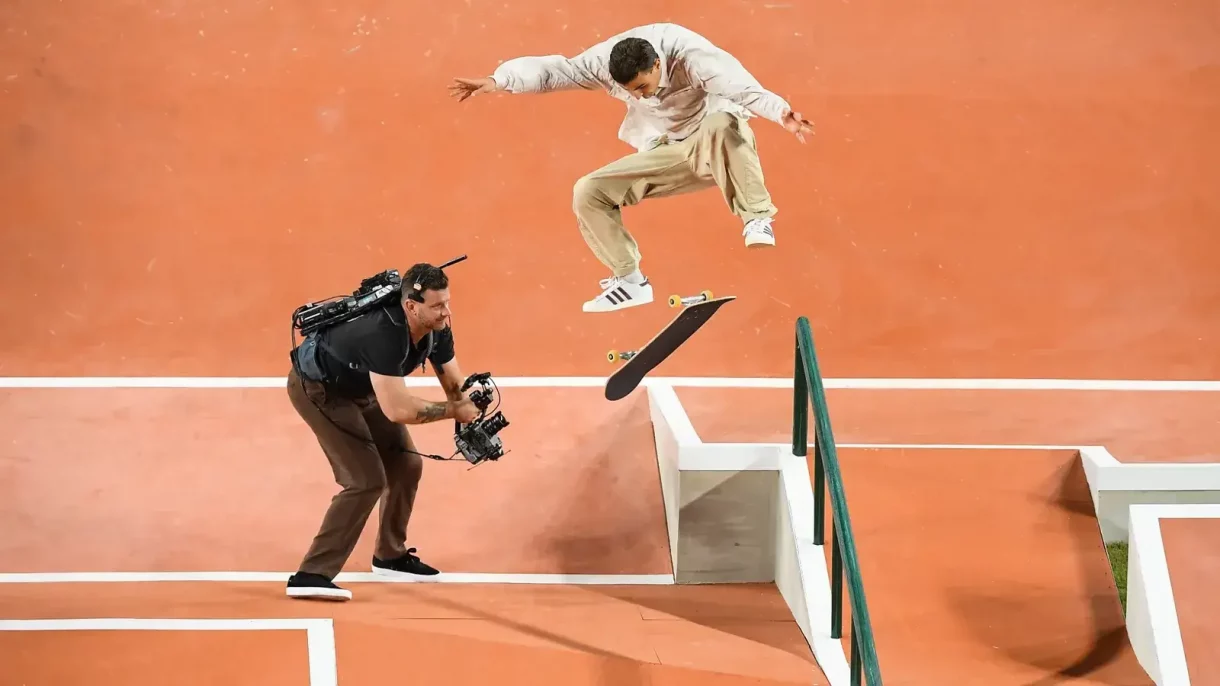
On Saturday 3 October 2026, Roland-Garros stadium swaps its clay courts for stairs, rails and ledges. The Street League Skateboarding (SLS), the leading street skateboarding circuit, returns to Paris for the third time, and to the stadium for the second time. The first two Paris editions sold out.
Whether you're in the stands or watching on a screen, I suggest looking beyond the tricks. What if you watched what happens just before them?
The trick is the part you see. Everything else is what allows you to land it with almost 10,000 people watching, as well as when you’re alone at the skatepark on a Tuesday morning.
In this article: the essentials on SLS Paris Roland-Garros, our two French skaters, a textbook case of handling pressure, what research says, and a 60-second routine to try at your next session.
SLS Paris Roland-Garros 2026: the essentials in 30 seconds
The Street League Skateboarding is the most high-profile professional street skateboarding competition. Each stop takes place on a course built for the occasion, with stairs, rails and ledges. Riders perform runs and tricks that are scored by judges.
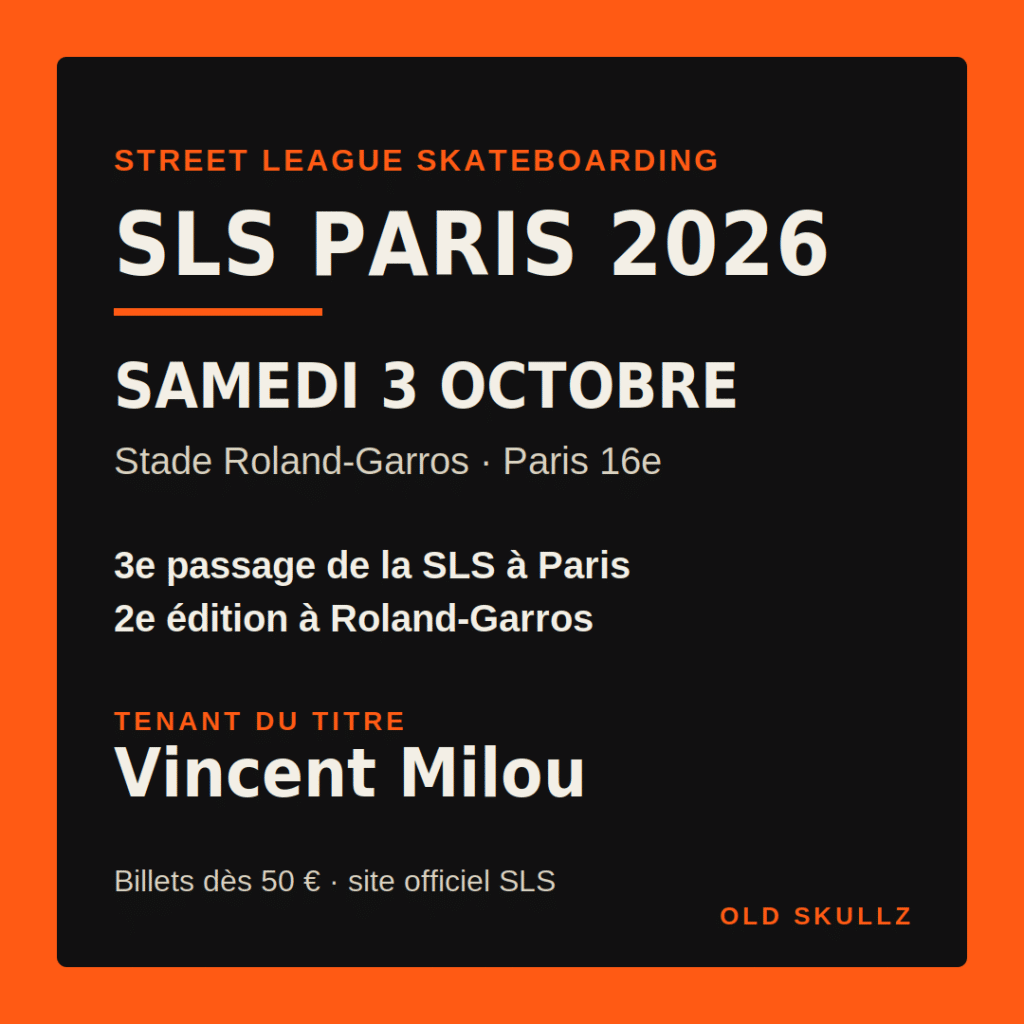
The men's line-up announced by SLS includes Nyjah Huston, Giovanni Vianna, Gustavo Ribeiro, Jagger Eaton, Chris Joslin and Vincent Milou.
The women's line-up includes Rayssa Leal, Chloe Covell, Coco Yoshizawa and France's Lucie Schoonheere. Always check the schedule and broadcast details on the official website before Saturday.
Vincent Milou and Aurélien Giraud: two French skaters who matter on the circuit
Vincent Milou arrives as the defending champion. On 11 October 2025, the skater from Bayonne took his first career SLS victory at Roland-Garros, on a packed Suzanne-Lenglen court, with 36.1 points ahead of Brazil’s Giovanni Vianna (34.8) and Japan’s Sora Shirai (27.6). He is defending his title on home soil and is the only French skater announced in the men’s field.
To us, Vincent is “the boss”: he joined our Skate Camps in Barcelona in 2023. Relive that week here: Vincent Milou at skate camp in Barcelona.
Aurélien Giraud, meanwhile, had won the very first Paris SLS in 2024. He is not in this year’s lineup: the organizers’ statement says he is continuing his recovery, aiming to return to competition in the best possible condition. We wish him the best possible comeback.
A useful reminder: even at the highest level, staying in the game is part of it. Check out our article on Aurélien Giraud.
Vincent and Aurélien aren't the only ones. More than 10 athletes who have been through Old Skullz have become French national team members, Olympians or professionals. They share their beginnings and journeys in our interviews: Max Berguin, Noé Montagard, Émilie Alexandre, Charlotte Hym, Robin Fournier…
Find them all on the page the pros who went through Old Skullz.
Case study: the mental demands of a run at Roland-Garros
Let's use Vincent's victory as a case study. I don't know what went through his mind that day, and I won't invent it. But I know what that setting demands of any rider.
A packed court. Thousands of eyes watching. Tricks he has landed hundreds of times. And a ranking with just 1.3 points separating first and second place. On paper, nothing new: it’s the same movement as in training. Yet this is exactly where it all comes down to.
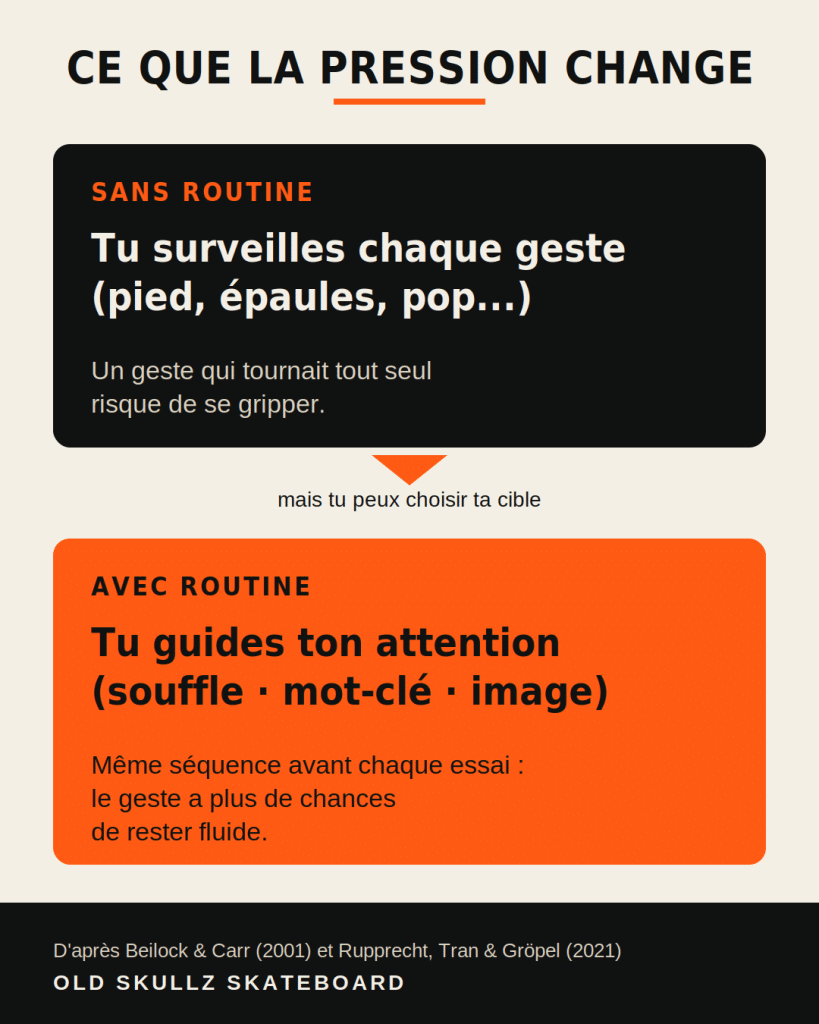
The psychologist Sian Beilock and his colleague Thomas Carr examined this paradox in a study published in 2001 in the Journal of Experimental Psychology: General. Leur constat, sur des golfeurs expérimentés : quand la pression monte, on se met à surveiller des gestes qui tournaient tout seuls, et cette surveillance les dégrade. L’étude montre que les golfeurs entraînés à réaliser leurs putts being used to being observed or being aware of their own performance (the self-consciousness training) became immune to pressure.). They had become used to that feeling of self-awareness, so pressure could no longer disrupt their automatic movement patterns.
One clarification: this was a laboratory study of golf putting, not a skate plaza. It's only a possible avenue for explanation and understanding.
Sound familiar? It's the “don't think about your feet” that every coach has said at least once. The moment you start analysing each part of your kickflip mid-run, there's a good chance you won't land it.
So, what are the athletes doing?
Anton Rupprecht, Ulrich Tran and Peter Gröpel reviewed 112 effects measured in studies of pre-performance routines : a sequence of thoughts and gestures, always the same, just before performing. Their meta-analysis, published in 2021 in theInternational Review of Sport and Exercise Psychology, finds performance benefits for beginners and elite athletes alike. The researchers also point out that a routine can help by reducing anxiety.
Remember: a routine is not there to bring you luck. It is there to give your attention a target at the moment when it would tend to get lost in fear of failure or concern about what others think.
You don't need 10,000 spectators to feel that.
Pressure doesn't need a stadium. It can be four friends taking out their phones to film. A parent at the edge of the skatepark. Your first skatepark visit after fifteen years away. A local contest at 16, or the day you return at 42, wondering whether anyone is watching.
In every case, your body can react in the same way: a racing heart and legs that no longer respond as usual.
If the fear of falling is your real brake, start with Afraid of falling while skating? Regain your confidence. Si tu veux apprendre à préparer un trick dans ta tête, lis our guide to visualisation in skateboarding. Et si tu enchaînes les blessures, this prevention guide will help you avoid going through the same situation.
That’s also what we work on with the riders we support, from pros to beginners: we don’t just learn tricks; we learn to land them when it matters. Like everything else, that takes preparation.
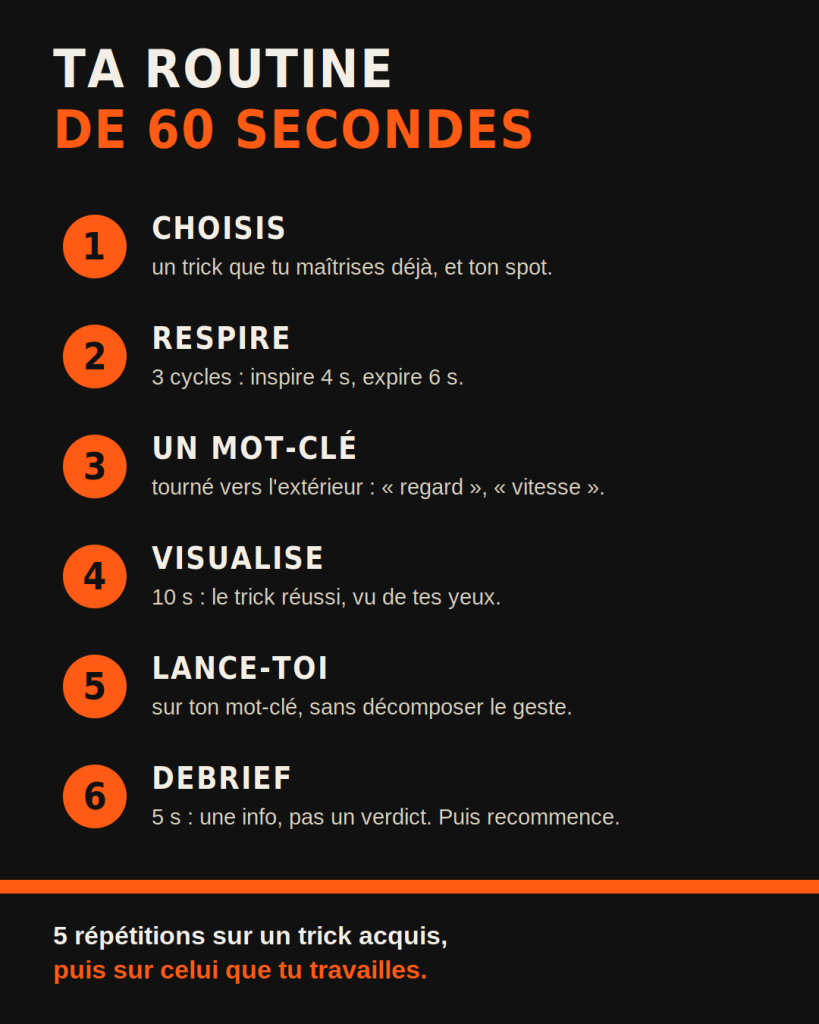
Exercise: your 60-second routine before a trick
Setup time: 5 to 10 minutes at the skatepark. Then the routine itself takes about a minute before each attempt. This isn't a laboratory finding: it's a practical application of the two ideas above.
- Choose a trick you have already mastered (not the one you are working on) and your spot.
- Breathe: three cycles, inhaling for 4 seconds and exhaling for 6 seconds.
- Choose a cue focused on the outside world rather than your body: “look”, “speed”, “landing”.
- Visualise landing the trick for 10 seconds, through your own eyes, including the sound of the wheels.
- Use your cue word to start, without breaking down the movement.
- Do a 5-second debrief: one factual observation, no verdict. Then start the routine again from the beginning.
Repeat the routine five times on a trick you've mastered to make it stick, then use it on the trick you're working on.
Example: you're at the top of a five-stair set and want to try your frontside 180 in front of your friends. You take three breaths, tell yourself ‘eyes’, spend ten seconds picturing yourself landing it, then go. Didn't land it? Tell yourself ‘too far ahead on the landing’: that's information, not a verdict. Start your routine again from the beginning.
Watch SLS from a new perspective, then build your routine
On Saturday, during the runs, watch the moments before each trick: the breathing, the gaze, the little gesture that keeps coming back. You won’t see what’s going on in their heads, but you may notice habits that repeat before each attempt.
If you want to build your own routine with an outside perspective and a clear plan, that's exactly what we do in the Old Skullz online skateboarding coaching : you progress wherever you are, at your own pace, with a personalized follow-up. You can also start with a video analysis of your trick.
Enjoy SLS, everyone, and have a great session.
Frequently asked questions about SLS Paris Roland-Garros
Sources and readings
Scientific sources
- Beilock, S. L., & Carr, T. H. (2001). On the fragility of skilled performance: What governs choking under pressure? Journal of Experimental Psychology: General, 130(4), 701-725.
- Rupprecht, A. G. O., Tran, U. S., & Gröpel, P. (2021). The effectiveness of pre-performance routines in sports: a meta-analysis. International Review of Sport and Exercise Psychology.
Sources on the event and athletes
- Street League Skateboarding: official announcements (tickets, SLS Paris 2026 line-up), streetleague.com.
- City of Paris: SLS Paris 2026 event page (date, Roland-Garros stadium, expected attendance, Vincent Milou's 2025 victory), paris.fr.
- NOSK8: SLS Paris 2026, scores from the 2025 edition and Aurélien Giraud’s win at the first Paris SLS in 2024.
- Ride or Die: organizers' statement on the convalescence of Aurélien Giraud (September 2026).
- Numéro 4 Skateshop: practical information for SLS Paris 2026 (tickets from €50, line-up).
- Old Skullz Skateboard: the ‘The Pros’ and ‘Vincent Milou at Skate Camps in Barcelona’ pages.
Suggested reading
→ Sian Beilock, Choke: What the Secrets of the Brain Reveal About Getting It Right When You Have To (Free Press, 2010): a book for a general audience by one of the cited authors.
